|
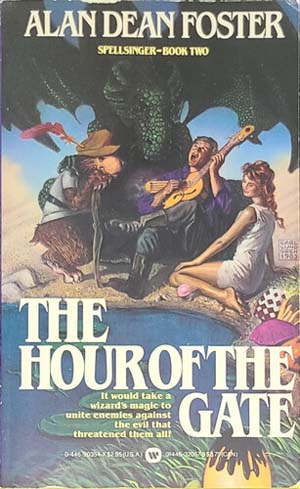
I enjoyed the first book in Alan Dean Foster's 'Spellsinger' a great deal, even if I rolled my eyes an awful lot while reading it. It felt earthy and progressive for a fantasy series, which was a positive, but it also felt like Foster had written parts of it while high, which wasn't. There are points in this second book, very much a second half to its predecessor's first, that match that and they're more the former than the latter. However, I felt cheated by the ending, as if everything before it could now be thrown away as no longer needed. That's unfortunate because that included most of what I liked the most. And so this becomes very much a mixed bag.
The positive side revolves around a quest within a quest. The broader one is still in effect, as the Plated Folk are still preparing for war and their threat is greater than it's ever been. We start as we ended the first book in Polastrindu, trying to convince that city's council to join them. That's a relatively short process, because once they convince General Aveticus, everyone else falls in line. However, Clothahump wants to bring in the Weavers, so north they go with that goal in mind. It's just the first step on the journey but the itinerary is relatively clear.
There's a useful map at the beginning of the book and it highlights that the landscape is almost a set of stripes. To the very west are the moors, about which we know nothing yet. Then it's forest, in which we spent most of the first book, in the Bellwoods, Lynchbany Towne and Thieves' Hall, all the way to Polastrindu. This book takes us from there in the very south through the grasslands of the Swordsward to the very north, joining the Sloomaz-ayor-le-Weentli, the Double River to take us east into the mountains. Then it's gradually south to Cugluch to infiltrate the Plated Folk, and finally back to the battle where we always knew we'd end up at some point.
I mention all of that to emphasise that it's a long journey that takes up a good chunk of the prior book and almost all of this one, that it's an inherently episodic journey and that we get invested into it along the way. Foster makes us care about these characters and, once we care about them we care about their fate, which means that we want them to get through and win over the people Clothahump wants on board so that their substantial combined forces can overcome those of the Plated Folk. It's a big deal and we're with these travellers all the way.
Now, they're not a consistent group. When they leave Polastrindu, it's Clothahump in charge, his bat familiar Pog in tow, and a wild collection of compatriots. Two are from our planet: Jon-Tom, a shortened version of Jonathan Thomas Meriweather, who seems to be the Spellsinger of the title even if he doesn't really know what that means yet; and Flores Quintana, a beautiful girl Jon-Tom had a crush on at college but who prefers to be respected for her brawn rather than her beauty. I like both of them, but I like the locals even better.
For instance, I was always on Talea's side from moment one. She's a tough warrior chick who likes Jon-Tom, who can't see her for his future because he hasn't got past Flor yet. She's local but also human. Many of the others aren't, like Mudge, a five-foot-tall Cockney otter in maroon velveteen pants; Caz, a gentleman rabbit who's an inveterate gambler; and Falameezar-aziz-Sulmonmee, a Marxist river dragon. You can see what I mean about Foster writing this while high? However, I'm on board with all his characters. Just wait till Bribbens Oxley joins the party. He's a frog boatman in tight snakeskin shorts.
I liked the journey, because Foster's greatest asset, seemingly from the very outset of his career but all the more so as he progressed, is his ability to conjure up wild and wonderful lifeforms in a variety of wild and wonderful environments. He has plenty of the latter to work with here, so it's no surprise to find that he throws in plenty of the former. And I don't mean the anthropomorphic characters like Mudge, Caz and Oxley. I don't even really mean Falameezar, who's a recognisably human character who happens to be caught up in the scales of a river dragon.
I mean the non-human characters who don't look like or act like humans at all. I'm talking about a collection of nude albino chanters with no orifices except for mouths, who were all created from the mucus of a giant fog called the Massawrath. I love that visual almost as much as I love how we have to get to it by submerging Oxley's boat into one river so that it comes out the bottom and joins another. I mean the Marching Porprut, which is a communal plant that stalks them through the Swordsward.
I mean the Weavers, who are of course giant spiders led by Oll, a grand web mistress black widow with an abdomen that's three feet across. The Weavers look like "a nightmare out of a Max Ernst painting, clad in Technicolor" and talk entirely in lower case. I mean the symbiotic relationship we see in the Iron Cloud, with great horned owls carrying lemurs, like Tolafay and her skymate Malu. These are all quintessential Alan Dean Foster characters, even if they're showing up in a fantasy novel where he can simply make shit up rather than a science fiction one where he would need to ground them.
All this is a lot of fun. I like how we move through the landscape and encounter these creatures. I like how Clothahump talks with many of them to explain the danger the Plated Folk bring and the reasons why they should join the fight. I should add that all this is completely unprecedented, as nobody ever traverses the Double River through the Earth's Throat to talk with Weavers. Nobody even thinks it's possible to get from Gossameringue-on-the-Breath to the Iron Cloud. Characters like the Massawrath make sure of that sort of thing.
What you might be wondering about, given that I haven't mentioned any yet, is how Jon-Tom has progressed with his spellsinging. Well, that's largely ignored for an astoundingly long portion of this second instalment. The first book and the series as a whole is named 'Spellsinger', so it seems like we ought to expect that to be a focal point. It certainly seemed like it would be last time out, with Jon-Tom getting hold of a duar and figuring out that he can work magic just by playing songs on it. Yet, I don't think we get any of those until the big battle at the end. Even then, we only get one real song, a rendition of Steve Miller's 'Fly Like an Eagle'. I felt a little cheated.
And, while I appreciated the eventual revelation behind the mysterious ace in the hole the Plated Folk have been cultivating. Foster builds that more here, with Clothahump reaching out to feel it within a trance and finding it a vast and dead mind, controlled zombie-like by Eejakrat, a sorcerer in Cugluch. I can't say a word about this without spoiling the surprise so I'll shut up, beyond adding that the visuals conjured up during the battle are fantastic and I would dearly love to see this in a feature film adaptation. In many ways, it's the Battle of the Five Armies at the end of 'The Hobbit' but with even more wildly diverse participants.
There are other things happening here. I was utterly shocked when one primary character dies, a fate I completely hadn't factored into where this was going to go. Foster capably builds the Plated Folk like an alien civilisation whose motivations are utterly different to ours, which both benefits and hinders them, depending on the circumstances. And there's some romance, though it takes a distant back seat compared to last time out. The suggestive play surrounding sex across different species is almost entirely gone. Of course, there's plenty of worldbuilding, much of which I haven't talked about because it's not important in the grand scheme of things.
All in all, this is far more traditional in its quest fantasy and the backdrop colouring that than the previous book, even if it breaks with that in some ways to make this a thoroughly modern fantasy.
It was published in 1984 but feels as if it's a product of the seventies. And I wondering where it will go next. 'Spellsinger' built the framework of the series as a conflict between the varied people of the west and their enemies of eons, the Plated Folk. Well, that seems to be over after what feels like an uneven duology; the books tell two halves of the same story but in oddly different ways. It feels emphatically over too, courtesy of what I didn't like about the finalé. I still want everything that happened before the battle to still matter.
Maybe the Plated Folk will be back in book three, 'The Day of the Dissonance', but it wouldn't feel right, I think. Their fight is fought for now. Maybe they'll be back in a millennium to try again, but not in the next book. I'm guessing there will be a new MacGuffin for the characters to get caught up with and hopefully Foster will return to growing them individually and together. Let's find out next month. ~~ Hal C F Astell
For more titles by Alan Dean Foster click here
|
|