|
Five books into Ruth Plumly Thompson's tenure as Royal Historian of Oz—and she would go on to write nineteen books, compared to series creator L. Frank Baum's mere fourteen—and I've found two strong views about her changes. One is that she loves wordplay and, while not every instance hits with equal power, the best of it is simply wonderful. The other is that she has a very different view of how Oz works to Baum and that seems to translate into changing things that shouldn't be changed. I'm all for the wordplay. I'm increasingly against the fundamental changes.
For instance, Kinda Jolly and Rosa Merry are the king and queen of Kimbaloo, which I'd see as fair enough. It's tradition to start out in yet another tiny kingdom of which we haven't heard a single word across every previous volume. However, this king made his fortune in buttons, which seems to be to be a fundamental change. Baum was keen to point out that there isn't any money in Oz. Thompson doesn't care. She's ignored that often enough now that it's surely a deliberate choice rather than an accidental slip. What's more, Kimbaloo is in Gilliken country, which is yet another change right at the outset. Why are Gillikins suddenly Gillikens when Munchkins haven't become Munchkens? Inquiring minds want to know.
Even though Kinda Jolly and Rosa Merry are rich and the rest of their tiny kingdom isn't, all their subjects are happy ones. Except, that is, for the cook, because we've met her before in exquisitely different circumstances. Way back in the second book, 'The Marvelous Land of Oz', she was Mombi the witch, the one who turned Jack Pumpkinhead into a sentient creature and, before that, Ozma into Tip. I remember all that. What I apparently don't remember at all is that, at the same time, she also turned Ozma's father, the king, into someone or something else, and he's been believed dead ever since. That, it seems, is not the case.
We learn this from Pajuka, who's the goose who's been delivered to the Kimbaloo kitchen to cook for dinner. Pajuka used to be the king's prime minister and, as soon as he sees and recognises the witch whodunit, he asks her what he did with the king. Unfortunately, when Glinda stripped away Mombi's magic, which was illegal anyway, she took her memory of past exploits with it. If it's true that she turned the king into someone or something else, she doesn't recall who or what. And so Mombi, Pajuka and Snip, who's one of the kingdom's button boys, hit the road to find out.
There's another fundamental change here that I don't recall from the Baum era. While I certainly don't recall the entire kingdom of Oz being vegetarian, I didn't acknowledge until now that eating meat is a particularly troublesome concept in this land. Pajuka was intended for the dinner table in chapter one. Mombi eats chicken in chapter five. Yet the former used to be the prime minister of the land and the latter... well, we don't know if that chicken was anybody, but that's the entire problem. All the animals in Oz talk back, sometimes with more sense than the people, and there's always the possibility that they could be your mother or brother or long lost love, transformed by yet another witch who's ignoring the blanket ban on magic. Do you want to take that chance?
After Thompson set up the story and prompted us to wonder about a lot more than she probably intended, she falls into the traditional episodic road template. Some of these transitory sections are fun and some of them not so much. If the presence of a town crier in Kimbaloo, one who cries whenever needed, implies a town laugher, whose name turns out to be Hah Hoh, then accepting that there are weeping willows would imply that of laughing willows. I like that, from a linguistic standpoint, but I'm also happy that we don't spend long with them. That would have got old very quickly indeed.
The Scooters are very cool, with their wings and long feet. I'd hang out with them. The dangerous Hoopers aren't and I wouldn't. Is Catty Corners a good one or a bad one? I'm not entirely sure, but I wouldn't want to mess with the Imperial and Puissant Pussy. Fortunately, while Mombi has a lot of fun there, cats and witches always natural together, she's able to counter their less palatable plans. While she doesn't have magic any more, she does at least have cookery and I'm won't argue against the power of that!
Usually, when there's one party wandering down a road in Oz, we're about to shift to another one and, this time, that turns out to be Dorothy, who's been visiting Perhaps City. We meet her as she leaves, so don't get a reunion with Happsies like Peer Haps and Percy Vere, but the prior chapter reminds us that there are characters in this book who we've met before, many of them, every one of them getting a fortunately brief introduction just in case we're starting into the series on book nineteen. Never do that, kids. Always start at the beginning but do so with patience.
Anyway, Dorothy has a rather unusual journey out of Perhaps City. A smattering of silver dust and a careless wish and suddenly she's thirty miles from Hollywood. That's quite the shift, but it seems that we should always be careful on Wish Way. Another careless wish and a motion picture dummy hurled off a cliff during a film shoot promptly comes to life. She rescues it and names it Humpy. A third wish and they're both back in Oz, in Gillikin country. Sorry, Gilliken seems wrong to me. What matters here is that, when she's in Oz, Dorothy is the little girl we expect her to be. When she's in the regular world, it has the nasty habit of wanting her to grow up to be her real age and that's a traumatic experience to be thrown unwittingly at anyone. Fortunately it's undone in a heartbeat.
Of course, these two journeys will inevitably merge at some point and Thompson happily adheres to that tradition. After a sojourn through eht Kcab Sdoow, where everything spoken or written is backwards—tub, rehtar ylddo, gnipeek sdrow ni redro ekil siht—they bump into Kabumpo and the bunch of them bump into the other bunch and off everyone goes to the Emerald City together, to do whatever each of them wants to do, even if they haven't told each other their true motives at this point. To aid hers, Mombi even throws Snip down a well, but, through the inevitable power of plot convenience, that turns out to be the last thing she should have done.
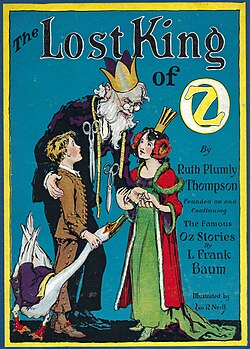
After all, our assumption from the very beginning is that, if Mombi transformed the king of Oz as well as his daughter and the title on the front cover is 'The Lost King of Oz', then he's pretty likely to be found by the end of the book. And, given that we haven't yet found a single viable candidate for that role, even though we're well into the second half, then he surely has to show up soon. And hey, who's this tailor at the bottom of that well, kept captive in Blankenberg for thirty years and has forgotten everything? His name is apparently Tora and, if you believe that, then I'm sure that I have a bridge in Brooklyn that I'd be happy to sell you. I didn't even need to set that one up. It's as immediately obvious as any revelation in this series has been.
While this is outrageously predictable and often frustratingly redundant—everyone gets to live their own stories and then recount them to each other whenever strands of plot merge, at least in relatively brief synopses—there is much fun to be had. The ending may be inevitable, but it's a section that Thompson handles particularly well, even with a reunion parade to follow. As always with her, the best fun is surely to be found in the wordplay, which is generally a little more subtle this time out.
It starts early in Kimbaloo, not just with the Town Laugher, though that's a good one, but with an invisible cook to replace Mombi, because an invisible cook would be out of sight. Ha. Mombi turns a lake into jelly at one point, which means that any fish still in it at the time will be jelly fish for a while. Sure. Remember those laughing willows? They're annoying enough for Mombi to threaten to have them "chopped down and up". That took a moment, but I like it all the more. There's also another strand of plot that's triggered by a golden feather descending from the sky to warn folk in the Emerald City "Danger! Go to Morrow to-day!" That's very cool. So are Tora's butterfly ears, which detach and fly off to hear things in all sorts of places.
In short, there's a lot of good here and much of it is due to Thompson's linguistic playfulness, but I still don't find myself entirely sold on her end results. It's like she's torn between what she wants to do with the series and what she feels like she has to do with it (perhaps with firm backing from the publishers). I'm hoping that she figures out the balance, because, when she's good she's very good but she isn't yet maintaining that for sustained periods. Then again, her worst novel is light years better than Baum's 'The Road to Oz', so I'm not too worried. It could be much much worse. ~~ Hal C F Astell
For more titles in this series click here
For more titles by Ruth Plumly Thompson click here
|
|