|
A month after the first issue of 'Weird Tales', Edwin Baird put out a second. That might sound like the plan, but it hadn't managed to establish itself yet, however many positive letters showed up 'The Eyrie'. Rural Publishing Corporation was still trying to figure out how to make this magazine work and it was open to change. For instance, this followed its predecessor as a typical-sized pulp that ran a long 194 pages in two columns. As of the next issue, it would bulk up to a larger format, with three columns, but shrink down to 124 pages. Issues five and nine covered two months rather than one and issue thirteen, the last under Baird and Rural, sprawled over three.
Readers in 1923 would also have noted a couple of things from the contents alone. For one, there are a lot of authors represented in issue two who had debuted in issue one, not just Otis Adelbert Kline, whose novelette 'The Thing of a Thousand Shapes' was serialised across the two, but Julian Kilman, Harold Ward, Hamilton Craigie, future editor Farnsworth Wright and the author of issue one's cover story, Anthony Rud. For another, like most of those names, many of the authors here were prolific elsewhere. It seems likely that a slew of them saw a new magazine put out a call for submissions and promptly threw a story its way. Most never wrote for 'Weird Tales' again.
That contents page looks daunting, with sixteen short stories, plus three novelettes, if we include that concluding serial, and the beginning of a new novella. That doesn't even include everything, as there's a vignette that isn't included, even though there's another that is, identified as a short story, and a whole bunch of short articles that are clearly there only to fill a page. They're mostly unworthy of mention, because even the few that seem interesting are over so quickly that they're mere glimpses of a bigger story and, while we can happily bring up Google today to find out more, that wasn't such an easy task in 1923.
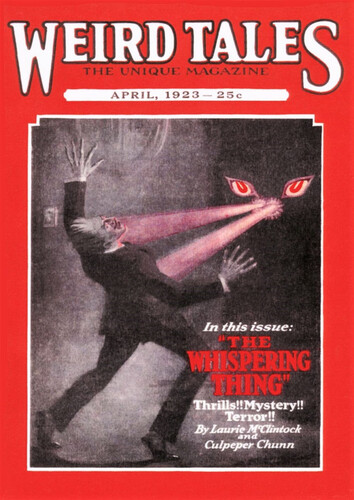
The cover story is easily the most interesting piece, even though 'The Whispering Thing' doesn't look anything like that artwork, as far as we're aware, given that it remains entirely invisible for the duration of this first half. It's interesting because of where it fits into a heritage, counting as an early occult detective story, two and a half years before Seabury Quinn would introduce Jules de Grandin, the most famous and prolific occult detective to grace the pages of 'Weird Tales'. Its lively lead is Jules Peret, known as "The Terrible Frog", and his prosaic policeman sidekick is Det. Strange. It seems to me that Quinn owes Laurie McClintock and Culpeper Chunn quite a debt.
However, I have to wonder how original McClintock, who only wrote with Chunn, and Chunn, who wrote a lot more stories on his own, not least the 'Old Bill' stories which mostly appeared in 'Ace-High Magazine' from 1925 to 1933, were. Occult detectives go back to the Victorian era and, while de Grandin and Trowbridge seem clearly patterned on Peret and Strange, it must be pointed out that Peret and Strange seem pretty clearly patterned on Hercule Poirot and Insp. Japp. However, Poirot and Japp were also inspired by Jules Poiret and Capt. Haven, the creations of Frank Howel Evans, and Poirot by Hercules Popeau, a detective of Marie Belloc Lowndes. There's a chain here.
Unlike Poirot, who was Belgian, most of these detectives were French, including Jules Peret. His origins are in the slums of Paris, but he escaped them for the United States, where he worked in plainsclothes for the police and then became a consulting detective. This case is sparked when M. Max Berjet leaps out of a window. Assassins, he cries before he's strangled to death by nothing, a fate that also befalls a passing doctor and nearly an artist too, Albert Deweese. The killer seems to be invisible, indiscriminate and prone to whispering incoherently. It's great setup, even before we go inside and find Berjet's valet dead inside a locked closet.
What's oddest is that we reach the point where this would end as a novelette, with Peret solving the mystery, but then it shifts. Rather than revealing it to us and the police, he gets twenty-four hours to prove it. We've already learned some things through judicious use of dactylography, the art we would call fingerprinting, but there apparently needs to be a lot more. Thus, enter Harvey Bendlow, former Secret Service agent, and the Wolf, Count Vincent di Dalfonzo. This is promising stuff and I'm fascinated to see where it'll go in the next issue. However, the authors didn't return with more from the Terrible Frog, focusing instead on more traditional detective stories for more traditional detective pulps.
The other serialisation here is 'The Thing of a Thousand Shapes', which concludes in this issue. We pick up with Uncle Jim dead in Peoria but not decaying and his nephew having bizarre dreams and being hit by a car. It belongs to Albert Randall, dean of the local college and an old friend of Uncle Jim, with his daughter Ruth joining him to pay respects. They're needed, because the locals think that they're getting sick and dying because Uncle Jim is a vampire and they're not far away from the traditional torches and pitchforks approach.
Albert, on the other hand, believes that he's still alive and the weird happenings in the first half is explainable through manifestation phenomena and elusive psychoplasm. Ruth takes to automatic writing to figure out a solution, which is good to see, and it all ends pretty well, even if the deaths of the locals are explained away a little too quickly for my liking. Sure, it's the logical explanation but angry mobs aren't traditionally swayed by logical explanations particularly often. Of course, a lot more would appear in these pages from Otis Adelbert Kline, who was also prolific elsewhere.
While we're on the longer pieces, the opening novelette is 'The Scar' by Carl Rasmus, according to the contents, but that typo fixed in the story itself, to Carl Ramus, M.D. It's a story out of time, as the hero of the story didn't start out too well. He's Dr. Herbert Carlson and he's given a lift by Dr. Clark Edwards, so they can talk about how much they like to see people die. Edwards is strongly in favour of the electric chair, while Carlson is rather fond of lynching, what he offensively calls "the Georgia treatment". They also talk about Ina Holden, a rich girl who's in the papers as a victim of kidnapping. Edwards was part of a team that operated on her once, in unusual fashion.
It's dated and talky until, well, it gets serious as Carlson is forcibly requested to attend a patient. No guesses as to who that will end up to, or how he figures that out, because this is predictable in that fashion. However, Carlson, who's been entirely happy with being dated and talky all along, turns out to be the heroic type; and so everything suddenly shifts into that mode, eventually finding an entirely different but equally predictable outcome. It's capably told but it's no weird tale. Ramus never wrote anything else and that doesn't shock me.
That leaves the awkwardly named 'The Bodymaster', another Harold Ward story, after 'The Skull' in the first issue. John Duncan is charged with the murder of a young man strangled to death by nobody at all, just like the victims in 'The Whispering Thing', except that he was raving about the Bodymaster as it went down. Dr. Darius Lessman, theologist and philanthropist, who maintains a private sanitorium outside New York City, testifies and pays the funeral costs, leaving only Patrick Casey, captain of homicide to believe Duncan's story.
From that setup, we progress to infiltration, captivity, escape, murder, safebreaking, the search for eternal life, mind control, out of body experience, astral travel, soul transference and even, in the end, romance. There's a heck of a lot crammed into a mere novelette, which means that Ward is far less routine this time out and far more interesting, even with that stupid name. It does kind of make sense and perhaps in 1926 it sounded a lot cooler than it does a century on, but it must be said that it sounds a lot more like an exercise machine being hawked on QVC. That's a shame. It's a worthy story otherwise.
So to the short stories and chief among those has to be 'A Square of Canvas', this month's piece by Anthony M. Rud, who seems to be everywhere right now. He provided the cover story for the first issue of 'Weird Tales', though 'Ooze' may be the weakest thing I've read by him. He was also in the issue of 'The Frontier' that I reviewed for its centennial in May, though that was a western story. This is easily the best of the lot, yet another story of madness, a theme that floods this issue, but it's surely the most gruesome of them all, with an ironic twist to cap it all off.
Hal Pemberton is a troubled kid but also a gifted artist, so his rich father sends him off to Paris in an agreement to stay away. To our 21st-century eyes, he's a budding serial killer with a particular artistic focus. He paints 'The Lusts of the Magi' in rabbit's blood and Maestro Guarneresi believes it's a work of genius. He doesn't change his mind when Pemberton slaughters the saddle mare he lent him and uses its blood for another painting, but he wants him gone. "Great but awful" is the new verdict. Needless to say, things escalate from there and they're as glorious as they would be half a century later when Roger Corman made 'A Bucket of Blood'. Seriously gruesome. I like.
Fortunately, 'A Square of Canvas' doesn't show up until halfway through, because no other tale of madness here is in the same league. It helps that they're all placed ahead of it within the issue, as not one of them would have played as well after it. Paul Suter's 'Beyond the Door' is effective but predictable; it benefits from the late Godfrey Sarston being a collector of dead bugs, which makes for a freaky setting. Roylston Markham's "fantasy of a mad brain", 'The Tortoise Shell Comb' is an awful lot skimpier, with a U.S. private bumping into a ghost story in France at the end of the First World War. He ends the tale occupying a cell at the Army and Navy Insane Asylum, but is he telling the truth or is he as crazy as a loon?
'The Living Nightmare' by Anton M. Oliver, is entirely about madness because the author pulls out the story that fuels it like a magician's tablecloth. That's a neat trick, given the setup. MacMillen is staying with the Mitchells, but Mrs. Mitchell's grandma dies, they leave and he remains alone in the house with the body, which nearly drives him mad. Hamilton Craigie's 'The Incubus' is a better look at madness than 'The Chain' was in the previous issue and, like 'The Living Nightmare', it has an effective twist, this one neatly ironic. Gerald Marston has accompanied Prof. Pillsbury into an Aztec tomb, but the professor trips and dies and the sailor runs, a hero who thinks he's a villain.
Madness combines with an ironic twist in 'The Snake Fiend' too, by Farnsworth Wright, a wild tale of revenge that succeeds, fails and backfires all at once. Jack Crimi loves Marjorie Bressi, but she marries another and he plays a long game to gain his revenge. I liked how it plays out without any of the characters having the full story, making it a far more substantial and successful piece from the future editor of the magazine than the vignette he had in the first issue. However, this is the point Rud's story shows up and these other five stories of madness fade away into the distance.
Wright's tale of revenge isn't the only such here. Victor Johns's 'The Hideous Face' is a double tale of revenge, in which the fact that the painter who hates roses is apparently mad doesn't matter a heck of a lot. What matters is why he's mad and how he gains revenge for that, prompting more in return. It's short but it has quite the bite. 'The Hall of the Dead' by Francis D. Grierson feels right but suffers for its inevitability. Annette Grey becomes a secretary for the renowned Egyptologist Prof. Julius March, whose previous secretary, Beatrice Vane, disappeared mysteriously. It's set up well but there's really only one place it can go and it goes there quickly and surely.
And with all those out of the way, I can talk about the more original short stories, though they're not all as successful as each other, even though they compete for how far flung their settings are. Artemus Calloway's 'Jungle Death' has its moments, a story set in on the Tropical Gem Plantation in Honduras against a backdrop of unrest, epidemic and voodoo. It has an effective ending, but it needed more heft. Julian Kilman's 'The Affair of the Man in Scarlet' is a very different tale to the tall one he told in the first issue. This is set in the 13th century during the reign of King Philippe, a beautiful young lady, Mlle. Bonacieux being sent to the headsman for execution, but finding love and a loophole in the form of an ancient Merovingian statute that could change her fate.
'The Conquering Will' belongs to Malcolm Rae, who heads into the northern wildernesses, when a deposit of tungsten is found in northwestern Canada. A crash on the rapids as his party gets close to their cabin leaves him the only survivor and his body shattered. He dies soon after but his soul hangs around by sheer force of will. The question is whether it can find a new body to occupy once his is torn apart by wolves. Carrol F. (really Carrol K.) Michener's 'Six Feet of Willow-Green' takes Allister into degradation in the east, addicted to opium. However, as a sailor, he saved the snake of Ssu Yin, who believes it to be his dead wife, and so the Chinese man owes him.
The least successful of these stories was ironically the most promising. It's 'The Forty Jars' by Ray Gillivray, though I'm not quite sure where Bo-hai is. Somewhere in the east again, I think, perhaps also in China. Selwyn Roberts has been driven there from excavations in Kulang, where he shoots a man, realises that he's white and nurses him back to health. His victim is Wade Hilton Bowen, of Montgomery, Alabama, a calliagraphist (sic) for the Central Historical Society. He's survived the Chinkies (ugh) by being immune to leprosy but he's sick off algae from Gileshtai the Accursed. His only hope is to use his key to a treasure cache of Kublai Khan before the Yengi can get him. There is more to this short story than that, but it ends as it's getting going and I didn't want it to stop.
That cuts us down to two short stories, plus a couple of vignettes. 'Golden Glow' is a decent story to close out the issue, but like 'The Scar' that opened it, it's no weird tale, so doesn't quite work. I assume it got in because there's a hint of ghost story, but it's not really believable even when it's being pushed, the mysterious old woman inside a mysterious abandoned house wielding a brand new automatic. Edward Triteham and Dr. Wilbur Hunneker get away and the rest unfolds cleverly but without any real surprise. We've seen too many 'Scooby Doo' episodes to be caught out by an outrageous disguise. I wonder how often Harry Irving Shumway fell prey to that.
'The Parlor Cemetery', however, I'm happy I've left for last as it's my favourite here after the Rud. It's told by a man working door to door to collect the details for a new city directory. "A tillyphone dickshanary", to use the words of the lady he interviews, the wary Ann Hay. The title refers to her collection of husbands, each of them cremated and kept within an unusual but oddly appropriate container on her mantel. It's all conversation, until it wraps up in nightmare, but it's wonderfully and characterfully told. I'm shocked that this is C. E. Howard's only published story anywhere.
That leaves 'A Photographic Phantasm' by Paul Crumpler, also his only published story anywhere, and a strangely presented one. All the stories here are told in two columns, one being reserved for the Eyrie and the odd filler pieces that flesh out pages. However, this one-page story is given to us in one column, suggesting that it's nonfiction. And it might be, in the way that some of the others might be, even if they're supposed to absolutely be, but it's really a quick ghost story. 'The Wish' by Myrtle Levy Gaylor, not listed in the contents, is even quicker even at half a page longer. It's a "careful what you wish for" story about Leonore, who gains a wish from a silver fairy and so grows up being unable to feel.
Talking of the Eyrie, there's little there at this point. Anthony Rud, who provided the first story in the first issue and its first letter, also becomes the first writer to have a second printed. However, none of the other correspondents are writers, that I'm aware of, just a set of grateful readers in cloud nine because there's suddenly a magazine for "this type of story". And so, a second issue of 'Weird Tales' ends, overlong at 196 pages but with some wonderful highlights.
Next month, in a larger (in format) but shorter (in length) third issue, we'll get the second half of 'The Whispering Thing', more from Julian Kilman and Hamilton Craigie, and another collection of new names, none of which look familiar to posterity. I wonder how many play alongside Markham, Crumpler, Rasmus, Oliver, Johns and Howard as writers who got a piece in print but rarely if ever managed it again, and how many with Suter, Calloway, Kilman, Olson, Michener and Grierson who were prolific writers across a swathe of pulps who presumably felt this market wasn't for them. ~~ Hal C F Astell
For more Weird Tales titles, click here
For more titles by Edwin Baird, click here
|
|