|
Volume 8 of 'Weird Tales' kicks off with an issue that plays well in the flow of mid-2026. 'The Devil Ray' wraps up this month and a new novel begins, 'Fettered', with its first part of four. There are two novelettes: the cover story, 'Through the Vortex', and another Jules de Grandin. Seven short stories include a 'Weird Story Reprint' from Nathaniel Hawthorne but mostly showcase a less well known set of names; five of them count as the first or only contributions for their authors in this magazine. One vignette and three poems, one of which is a reprint, presumably going back to the Victorian era, complete the line-up.
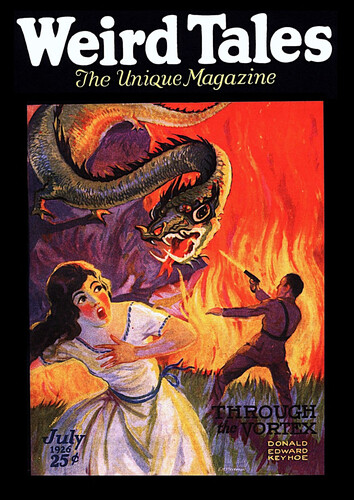
The longer pieces dominate, the first two taking up a third of the issue. 'Through the Vortex' is an enjoyable but ultimately rather ridiculous cover story from Donald E. Keyhoe, who had appeared twice with short stories already and had another novelette to come in 1927. It starts out as if it's science fiction, an airman hearing eerie sounds on the island of Guam and his commanding officer going up in an experimental VR plane (and I have no idea what that stands for) to investigate. But once he reaches 43,000 feet precisely at midnight and finds his plane sucked upwards quickly with a shriek, to descend into the fiery depths amidst monsters raging in a pit, it's shifted into fantasy and it stays there throughout, almost an Edgar Rice Burroughs type of story.
Put simply, he's found his way to a sort of Sargasso-of-the-air, a small aerial island that he realises through radio experimentation is moving in a regular arc. He's not the first to get there, as the three survivors of a lost dirigible called the 'Fidelis' are there and settled because there's simply no way to leave. Alexander Faire, his daughter Madeline and his secretary, Hugh Fletcher, keep a neat home in their Refuge, with filtered water, forlite torches made of weed and even some high power teolin explosives. That's useful when the local population is violent but sentient green ape men. Of course, it all ends happily, at least for most of them, with poor science but good emotion.
The novel does better, courtesy of Greye la Spina, well-known to 'Weird Tales' readers for a string of four short stories and two longer serialised pieces. It seems pretty clear to me where it's going but this is only one part of four, so I'm open to it taking unexpected turns. I don't know where the characters are, but it's rural and remote and Ewan and Bessie Gillespie can only get to their cabin by canoe. They're twins and he's there to paint, but the story ties to the weird relationship that's set to build between them and their nearest neighbours, Dr. Dale Armitage and his wife Gretel.
It doesn't get off to a good start, with Dale angry at their visit and Gretel ill in the background, a background that's deepened by the fact that there are bars on all their windows. The doctor tells them worrying things. He's thankful that the Gillespies' cabin is on the other side of the stream, if merely half a mile away. While that suggests that she's a werewolf, he later pleads them to never invite her into their cabin, which seems more like protection against a vampire. Maybe she's both.
Either way, she's obviously an imminent danger and she proves that when she inevitably finds her way over, easily the most dominant character in the story, and we're forced to decide who to trust in a whole slew of different combinations between just four characters. It's a masterful build and I love that Bessie is the lead but Gretel is the power and the two men are either stuck or helpless in their wake. I am eager to see where this novel goes over the next three months. It has some huge promise and I dearly hope it lives up to that and doesn't descend into predictability.
The other long piece is a Seabury Quinn novelette, 'The House of Horror', which is the sixth story with our favourite user of Belgian exclamations, Jules de Grandin. Morbleu, Friend Trowbridge! I found it initially weak, with Trowbridge and de Grandin lost in a storm failing to reach a child who needs treatment for diphtheria. That never happens. C'est la vie. Instead they find Marston Hall, which Trowbridge doesn't recognise, even though he lives in the immediate area. It feels like the author didn't know how to start the story but he absolutely knew how to end it and that's what he felt counted. And he isn't wrong.
Something's clearly wrong at Marston Hall, but Quinn plays with us, making us think it's minor and then rooking us between the eyes with something outrageously gruesome. So there's a girl there who's ill, but she's really drugged and they're welcomed prisoners. That's hard but it doesn't even hint at where we're going. It doesn't even matter that the end is convenient in two ways at once: a timely death and rain solving a moral quandary. What matters is how brutal this gets, part serial killer story and part the ending to 'Freaks'. It's therefore memorable for the lengths it goes in its most crucial moment, after a weak start and before the conveniences, and I won't forget that in a hurry! Par la moustache du diable!
That may well be half the issue between three pieces, because the third third of 'The Devil Ray' is merely eight pages long and so nestles in like a short story, but I'll whip through the rest of these contributions in shorter bites, starting with 'Laocoon', the first of fourteen eventual stories for a pseudonym, Bassett Morgan, who was really Grace Ethel Jones, one of either six or seven female writers represented in this issue. Prof. Denham of the University of California resigned in ridicule after asserting sea serpents still exist. Willoughby is a football star who studied under him and is now taking a job under him for $3,000 a year, off Papua. The sea serpent turns out to be real, but it's up for debate as to how much of the rest is. I liked it.
Oscar Cook would also go on to write more for 'Weird Tales', but 'Si Urag of the Tail' is only a first of four. It's also set in the South Pacific, on the Luago River somewhere, perhaps, in Borneo, with a white colonial policeman trying to solve the mysterious deaths of many people in nearby villages, including a bunch of his native staff. It's an agreeably weird tale, with Si Urag an agreeably weird character, with a four-inch tail that he sticks into the ground and a body suit of vivid tattoos of a plant that eats human beings. It's almost a lost-race story but it chooses eco-horror instead.
Leslie N. Johnson and Elizabeth Adt Wenzler are represented by their only pieces, but the former would write a couple of stories for 'Black Mask' in 1928 and the latter featured in a pair of letters later on. Johnson's piece is the vignette, a page and a half about Dr. Blaas, a convicted murderer who would rather die by his own hand claiming his innocence than be hanged as a guilty man. I'm not sure how that works but he's committed to his premise with irony awaiting him. Wenzler's is a neat tale of legend, set in a cursed and empty castle in Lorraine. "None but Romnare blood shall be tolerated within these walls!" swore its last lord, who summoned Lucifer himself to its defence.
Fast-forward to the present day and Countess Adrienne of Paris stirs everything back up again as she decides to hold a ball in the castle. Eugene, who lives in the local village of Saviennes, accepts an invitation to play in the orchestra, much to the horror of his family. When he doesn't return, it falls to his sister Mignon, after a series of visions, to rescue him. The ball was cancelled, he's now the violinist in the tower and the local witch explains. There's a lot packed into a short space here and the ending is fascinating. Is this rescue? Tragedy? Crossroads deal? And when did it become a werewolf story? I'd like to have read more from Wenzler, but there's no more to read.
After Quinn and La Spina, E. Hoffman Price is the biggest name not being reprinted here, but I'm not particularly fond of his story, 'The Dreamer of Atlânaat', partly because it feels contradictory. Ismail, chief wazir, reads records and thinks back nine centuries to when he was in the stories they tell, as an enemy to high-rising Haaj Isfendiyar. He's outmanoeuvered, so the sultan believes that he mounted an assassination attempt that he didn't, but had planned. So far so good, but then he is found in exile by Ismeddin the darvish who brings him before the Lord of the World in an ancient ruined city and I lost track of who was alive, dead or somehow both.
'A Runaway World' is one of those wonderful stories set in an almost unfathomable future year of 2026. By then, we'll have established contact with Mars, Venus, the moons of Jupiter and beyond. It's a story about nested universes, each one being an atom in another. In this universe, President Bedford of the Republic of the United Americas is establishing his new capital in Central America. Yeah, not quite how things worked out. However, the story veers away at this point to show Mars leaving its orbit for no apparent reason and Earth following it, the families we stay with finding a way to survive a three-year journey to a new sun. Why, I have no idea, but it's worthy. The author is Clare Winger Harris and she'll have another story the following year.
'The Elixir of Life', "a five-minute story" by Marc R. Schorer and August W. Derleth, is a beginning to a prolific partnership between this pair. They would write five together in this billing order and then reverse it for fourteen more, presumably as Derleth established himself as the bigger name. It's a skimpy piece, longer than the vignette, 'With the Coming of Dawn', but only by a page, but it feels a lot more substantial than its length suggests. It's about the Duke di Sforza, who's seeking the elixir of life from magician Messer Girolani. There's only one component left, the life-blood of a child, so he sends out for that and, while the ironic ending isn't surprising, it's handled very well.
That leaves the 'Weird Story Reprint', which is the thirteenth and a second from the author who provided the second. He's Nathaniel Hawthorne and the story is 'The Birthmark', a subdued story compared to the last few but still an effective one. A scientist marries a beautiful woman, who is perfect in every way except for a single blemish, a red birthmark on her left cheek that looks just like a fairy handprint. It's long and talky and clearly this man doesn't understand the concept of the beauty spot, but then he's doomed to another ironic ending.
One reason why there are so many female authors in this issue is because there are three poems and two of them are by women, hardly an unusual state of affairs for this magazine. However, if it suggests that poetry was generally seen as a more acceptable outlet than prose for women, that doesn't explain why the novel and at least three short stories here were also written by women. I have a feeling that editor Farnsworth Wright really didn't care what gender an author was as long as the writing was good and the readership of 'Weird Tales' followed suit.
The reprint is the only poem by a male author, Edmund Clarence Stedman, who lived from 1833 to 1908 and, if 'Salem' is anything to go by, wrote in a notably olde worlde fashion. Maybe he chose a deliberately archaic form to tell of Salem witches, this piece, an unusual sestain in ABCCAB rhyme scheme, written to Mistress Anne by her neighbour before she goes to hang, over a full page.
The new pieces, the two by women, are shorter, 'Fear' by Cristel Hastings a sestain that's done in one verse, using a much more traditional AABBCC rhyme scheme. Louise Garwood's 'Ghosts' takes three but in highly recognisable AABBA form, technically making it a limerick, albeit not aimed at humour and without that particular rhythm. I like this one a lot, not least because it manages to sneak "violoncello" into the final stanza. It's effectively atmospheric and Garwood must have felt a kinship with the subject matter enough to write a later poem, 'Ghost', which also appeared in a 'Weird Tales', for December 1931.
I believe I've glanced at everything now except the conclusion to 'The Devil Ray', serialised over a three-issue span. This one changed as it grew, becoming quite the cliffhanger serial. You'll recall that it's about Lindley Fenshaw, for a while the master thief Ferris, who seeks his stolen father in the Castle Blennerhof, amidst the threat of the purple death, the Leipische Ray. We join him as he and the Baron's niece seek entrance to the castle's tower, where they'll have eighteen minutes to free Fenshaw Sr. and escape before the bombs secreted in the moat explode. Given how much this covered over its two previous instalments, it ends relatively mundanely, if rather frantically. The boxes all end up checked, but that's very much the only point of this ending, freakish imagination expended earlier.
There are other things worthy of note, though, not least the first thing we see when we open the covers. That's what appears to be a short story called 'Disappearing Bullets' by George J. Brenn, but isn't. It's just the beginning of one that was published across three issues of 'Detective Tales' in 1922 and 1923, and it morphs into an advert, for a bundle of a dozen novelettes, available for a measly dollar, post paid. I wonder how many of these novelettes are still circulating today, in their "convenient pocket form" with "handsome two-colored covers". This feels like a modern scam to hook people, but it's rather effective. After reading a column and three quarters, suddenly we'll want to know what happens next to Experience Smith, master detective. Take my dollar!
There's also a full page ad for 'Weird Tales' itself. Apparently they still had copies of the "gigantic size anniversary number" that combined May, June and July of 1924. That was a huge issue, at 196 pages, priced at fifty cents, double the usual cover price. Oddly, it talks up three stories without a glimpse of Harry Houdini, Otis Adelbert Kline, H. P. Lovecraft, Seabury Quinn, Henry S. Whitehead and C. M. Eddy, Jr.'s notorious 'The Loved Dead'. But hey, "mail your order in to us to day before it is too late." It's a hundred years on. I think I'm too late.
And then there's the Eyrie. Talk this time mostly surrounds 'The Ghosts of Steamboat Coulee', the cover story for the May issue, which I thoroughly enjoyed. So, it seems, did everybody else, as that topped the ballots for that issue and readers felt the need to talk about the best story printed in 'Weird Tales' before that. 'Whispering Tunnels'? 'The Tenants of Broussac'? Maybe 'The Phantom Farmhouse'? Of course, there's no definitive answer. There's lots of praise for Jules de Grandin, of course, and one correspondent asked where H. P. Lovecraft was in that issue, as "He is the noblest Roman of them all." Not your typical compliment, but hey.
It wasn't all positive though. Some people hated the indefinite ending of 'Lochinvar Lodge" back in March, a novelette by Clyde Burt Clason,, while others were more than happy with it, bringing up 'The Statement of Randolph Carter' in comparison. One complaint I'd thoroughly agree with is the plea to stop running tales like 'The Derelict Mine'. It may be a good story, says W. R. Kirkland of Albany but "it is out of place in 'Weird Tales', as there is nothing weird or mysterious about it." It felt out of place to me too.
Next month, more from 'Fettered' and a bunch of recognisable names. The cover novelette, 'The Woman of the Wood', is from A. Merritt. There's a Lovecraft, albeit one I don't remember, and an August Derleth, solo this time. There's also the debut in print of Edmond Hamilton, who would go on to become one of the most prolific contributors to 'Weird Tales'. And the 'Weird Story Reprint' is one I remember fondly, 'The Horla' by Guy de Maupassant. See you when that hits the stands! ~~ Hal C F Astell
For more titles by Farnsworth Wright, click here
For more Weird Tales titles, click here
|
|