|
I already knew a number of the authors who wrote for 'Weird Tales' (what's the collective noun for authors—a writer's block?) but, six months in, I'm starting to recognise even more. There's a new Jules de Grandin story and another Surgeon of Souls; I know Seabury Quinn pretty well by now and Victor Rousseau is suddenly showing up everywhere. There's a sequel to Everil Worrell's 'The Bird of Death' in the previous issue, the middle part of Edmond Hamilton's novel and the last in Greye La Spina's. The Weird Story Reprint is by Charles Dickens and there's a Whitehead and a Derleth, who I knew coming in and an Eli Colter, who I didn't know well.
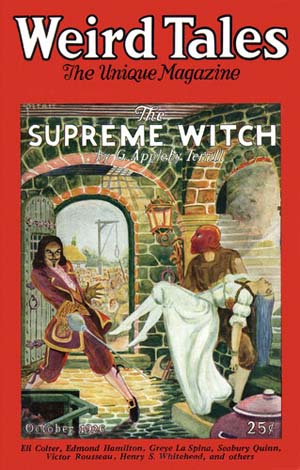
The cover story, however, is by a new name to me, G. Appleby Terrill, with his first contribution to 'Weird Tales'. He'd have four, all told, but three of those would be this one, 'The Supreme Witch', the only exception 'The Church Stove at Raebrudafisk' in February 1927. Oddly, it's a reprint, but an unacknowledged one, previously published in 'Pan: The Fiction Magazine' in April 1924. He was a British author, far from the most prolific writer in this issue but he had a consistent output from 1918 to his death in 1928 in varied markets, mostly general fiction
'Weird Tales' would seem to be a good market for this story, because it's a genre hopper. Initially, it's historical fiction, set in the days of the Jacobites, with four such sat around a table as we begin. However, the focus soon shifts over to one of them, Mr. Lambardiston, who tends to be known as Old Jem. He's a former member of Parliament and the current Lord of the Manor, but his story is an old one and predates both, concerning the young Jem's encounters with witchcraft. There are two witches in play and Jem is obsessed with both of them, first Ellen Shafto, who's hanged, then her daughter Nora, who ends up condemned to the same fate.
So, a historical story, but it's more than that. There's plenty to tip it over the border into horror at points and, by the time Nora Shafto reaches the hangman's noose, it fairly drifts over another into science fiction. Yeah, that's intriguing, huh? It's a decent story just on the face of it, but it's a better one when it reaches its unexpected conclusion and better still when we let it linger in our memories. It's a haunting piece and it makes me look forward to Terrill's only other contribution next February and wish he'd written more weird tales.
It's followed by another genre hopper, this one from John Martin Leahy called 'The Voice of Bills'. Unlike many writers, who were prolific either in 'Weird Tales' or across markets, Leahy only wrote a few stories, one a year for six years and then a bonus tacked on the end. Most of them were for 'Weird Tales, including two of his three novels, one novelette that became a Weird Story Reprint and all three short stories. His only other work was a novel published in 'Science and Invention', a publication I'm getting to know pretty well right now too.
It's a western that cleverly opens with some famous last words. Slickmer is congratulating himself on killing Bills and leaving no trace of his crime. They're up the Snoqualmie, so Washington state, and in a deep forest. Arguably his only mistake is to confront his victim to gloat before killing him. We never find out what he thinks Bills did to affect him so, though the latter cries innocence, but it's a long and much relished vengeance until Bills curses him. And then we shift into a Poe-esque tale of mental torment in the vein of 'The Tell-Tale Heart'. It's decent but already eighty years on from Poe, who did it better even if not as a western.
I'd run quickly through Orlin Frederick's 'The Throwback' because it's a vignette of a story at only a page and a half. It's not just short, it's too short, except that it's a debut. The throwback of the title is Heinz, a Belgian of German parents and a corporal, presumably in the First World War. Oh, and perhaps a werewolf? It's capable enough but it's just a glimpse, not just at a story but at the author. Orlin Frederick was a pseudonym of F. Orlin Tremaine, who would be a prolific writer over the decade and a half from 1933 to 1949, mostly for 'Astounding Stories'. This was his one and only piece for 'Weird Tales' but also his first in print anywhere, so important for him.
And, while we're still going through in order, which isn't something I normally do, up next are the two series, a Jules de Grandin and a Surgeon of Souls. The latter is an odd story, as Miss Suydam, a cured former patient of Dr. Brodsky, visits him with concerns about her sister. A ghost appears to be foreshadowing her death, which ties to an old family legend and prompting her to waste away. It comes down to her adoring husband, Walter Fotheringham, who believes she's perfect in every way except for her nose, which thus turns out to be the cause of the problem. I like it more than I did the first, which is promising, ahead of the third next month.
Jules de Grandin will skip an issue though, because they're not reprints. This eighth instalment in the series is a tamer one than usual, more suggestive than gruesome and not that suggestive, as it's reminiscent of a 'Hammer House of Horror' episode without any nudity. De Grandin's hiking in the New Jersey woods with Friend Trowbridge, wondering about a place to rest, when they come upon a secluded mansion populated by lovely young ladies dressed in classical white garments. It seems odd even before one comes running towards them raving at the sight of Pan in the bushes.
It turns out to be a school, the School of the Worship of Beauty, presided over by the gentleman in a wreath of laurels who's playing the zither while the young ladies pray. He's Prof. Herman Judson and... well, you'll have to read the story to figure that out. All I can say is that, one sacrificial goat excepted, you won't get far by extrapolating from the far more gruesome earlier episodes in the series. I'm guessing it may have been inspired by the far more famous Arthur Machen novella that bore the same name, which was three-decades-old at this point, but that's the superior piece.
Going from series to serialisations, there are two in this issue, plus a sequel that turns out to be a lot better and more substantial than its original. That's the novelette 'Cattle of Furos', set a year after 'The Bird in Space' in the September issue. Frank Alison is still having nightmares about the experience he had at Castle Rock and decides to go back but with a plan this time, equipped with food, poison and a gun. He gets there early to make sure he's ahead of Gorlog the double-jointed green alien and the Bird of Space that takes him and his kidnap victims to his home planet.
Instead, a giant snake places him on the bird and off he goes. Now, it isn't really a giant snake but you can probably figure out what it is on the grounds that transporting humans across planetary distances on the back of a giant space bird doesn't seem like the healthiest option. Everil Worrell has that figured out and she's also designed a structured caste system for Gorlog's planet that is not only reliant on human beings to work it. Unlike the first story, this one has actual science that bolsters this culture and plenty of action too.
It's a better story than its predecessor but it leaves so much open for a third that I don't believe ever came. However, rather happily Mrs. Everil Worrell Murphy did keep the stories coming, with most of her entire output printed within the pages of 'Weird Tales', sixteen more short stories or novelettes to come, albeit considerably spread out over thirty years. Another author starting out but with a substantial career to come is Edmond Hamilton, who debuted in August with his short story, 'The Monster-God of Mamurth', which the Eyrie reports was the second most popular of the issue, and continued in September with the beginning of his novel, 'Across Space'.
This middle instalment finds Prof. Allan and Dr. Whitley captives of the creatures who live inside Easter Island. They're humanoid but winged and reptilian, with faces just like the statues above them on the surface. They're taken down tubes to an ancient city, which is largely empty because this culture has dwindled over time, thus prompting their actions with the planet Mars. It seems that they're from there and they need those still there to aid them in taking over the Earth. This is hokum but it's fun hokum, trawling in plenty of subgenres. It wraps up next month.
Wrapping up right now is Greye La Spina's 'Fettered', with its fourth and final instalment. I've had a blast with this novel but it chose to only briefly expand beyond the four principal characters in a flashback scene to give us a little background. Otherwise, we've been confined to the woods with the twins, Ewan and Bessie Gillespie, and their nearest neighbours, Dr. Dale Armitage and his wife Gretel. The doctor is the fettered character because Gretel is a vampire and, quite frankly, we all knew what needed to be done long ago before the Gillespies ever paddled up the river. Therefore, I can't say that it ends strongly, just inevitably.
Eli Colter is a name that I recognise but can't associate with anything yet. 'The Corpus Delicti' is a strange tale that highlights how the author, a pseudonym for May Eliza Frost, so another regular female author in 'Weird Tales', wrote even more western stories than she did weird ones. This is a campfire story, a quartet of men listening to Hasting telling a story of two women, both dead, so he can ponder on which he truly loved and which was just a passion of the moment. Burgensdorf needles him during his recital, to the degree that we're not entirely surprised by the revelations that follow.
However, while we might have picked this angle or that one for the twist, we aren't likely to have picked more than one and that's where this picks up extra credits. I enjoyed it a great deal, being a story that's at once inevitable and surprising. That's not an easy balance to walk but Frost finds a way to do it and I only have a problem with one particularly convenient component. Otherwise, I like it a lot and look forward to more.
She was clearly a dedicated professional writer who had first reached print in March 1925 but had knocked out an impressive amount of work in her first year and a half. That output included a pair of short stories in 'Weird Tales' and a serialised novella earlier in 1926, 'On the Dead Man's Chest', but also thirteen other short stories and a novella in other pulps. She'll return to 'Weird Tales' in January 1927, but would see seven other stories in print before then. I don't believe I have any of them, most of my western pulps dated to later years.
I've read Henry S. Whitehead before in collected form and in anthologies but I'm enjoying reading his weird Caribbean stories as they came out, albeit at the remove of a century. This one is called 'The Projection of Armand Dubois' and that may tell you all you need to know about it, if you know his work. We're on St. Croix this time out, where Gerald Canevin is interviewing his septegenarian neighbour, Mrs. Minerva du Chaillu. He shows her his stories so she settles down to tell him one he can use.
Back in 1880 or so, she visited her husband's study while he's in his strongboxes. She sees a couple of promissory notes that show that he lent three hundred dollars to two different people in 1863 but never called in the debts. They're worth seven hundred and fifty now, given the interest, and she hires a notary to collect. Both men cough up what they owe, but Armand Dubois is ugly about it, deciding to visit her in miniature form and hurl liquid at her. Like you do. It gets weirder before the inevitable revelation. I like these stories and I like that they keep on coming.
On the other hand, the August W. Derleth story is another short short, over and done with in just two and a half pages. That's forty per cent more than the Orlin Frederick and that helps, but not enough to allow it depth. It's Derleth's third solo effort for 'Weird Tales' and it's easily the best, a gruesome little number about a narrator sentenced to 'The Coffin of Lissa' by the Inquisition. It's like an iron maiden, without the internal spikes but with holes for the arms so the rats have meat to gnaw on. It's short and it doesn't offer any respite, except for the possibility that it's all just an insane dream of a lunatic with missing fingers.
That leaves four short stories from four authors, only one of which I've heard of. Of course, so has everyone else because he's Charles Dickens, with the Weird Story Reprint, 'The Bagman's Story', a tale extracted from chapter forty-nine of 'The Posthumous Papers of the Pickwick Club', later far better known as 'The Pickwick Papers'. It's a quirky romance with a supernatural element, as Tom Smart heads over Marlborough Downs towards Bristol and stops at a roadside inn. There's an odd chair in his room. He has a drunken conversation with it, takes its advice and lands himself a wife. It's a fun tale that reminds me that I really ought to read more Dickens.
So to three names entirely new to me, Marion Heidt Mimms, Frank Owen and H. Thompson Rich. This is Mimms's only contribution to 'Weird Tales' of her five published stories, but the other two were prolific writers with multiple stories in this magazine. They're all decent, but the best is the Owen, which is 'Seven Minutes', his twelfth 'Weird Tales' story from almost three times that and a plentiful output for other pulps from 1915 to 1958.
Dr. Gordon Winwood leaves New York City in a blip, with his wife Coralie and his coloured assistant and best friend, Barlow Garth. You see, Dr. Winwood is a spiritualist and his wife has died. The two left behind brought her back fifteen minutes later, but there's no spirit in her body. However, if he can't bring her to him, maybe he can go to her, so he sets up a plan to die temporarily and recover Coralie from the world beyond. I won't tell you how that goes but I guess I'll give it away anyway by pointing out that this is a sad and very effective piece.
The Mimms treads similar ground in a very different way earlier in the issue. In 'The Chair', Alan Carvel performs an experiment at night. He's a medical school student working to restore life to the dead. He has a suitably unsuitable body to try it on, that of a murderer, Beaster Young. With supreme irony, he escaped the electric chair only to cut the wrong wires during his escape and die from electrocution anyway. Anyway, Carvel succeeds and then has to figure out what to do with a newly resurrected murderer. He lets him go. Fast forward a few years and Dr. Alan Carvel realises that the witnesses in Beaster's case are being murdered, with only two left, one of whom, Berne Whitney, is his friend. It doesn't end as well as it starts, but it's enjoyable, if nothing more.
And with a brief mention for A. Leslie's poem 'Grave Chains', which does what it does well enough, that appropriately leaves an ending to end on. It's 'The Phantom Express', the last story of eight by H. Thompson Rich, a prolific author from 1915 to 1952 in a wide variety of markets. It's another short short, at two pages halfway between 'The Throwback' and 'The Coffin of Lissa'. Therefore, it works only as a brief vignette but a short but sweet one. Engineer Hadden looks at an icy, stormy night and takes the Transcontinental out, avoiding calamity by... well, you'll have to read it to find out. Hey, it's only two pages long!
Before I dive into 'The Eyrie', I want to highlight a glorious half page of ads at the very end of the issue, opposite the end of the cover story. It's four supposedly unrelated ads, with the last three telling an unexpected story. The first is one of those gun ads that boggles the mind of a Brit, with a couple of options for handguns available for order through the mail without background checks or indeed any money. Just pay the postman when he brings you your gun. Or maybe shoot him to avoid payment. It just makes no sense to me.
Then there's a birth control ad. "Don't take foolish chances and suffer later". Order this book for the real facts about "Birth Control and Sex Life". Especially if you have too many children. With that in mind, let's increase your odds of needing birth control by clearing up your pimples, "often in 24 hours", with Clear-Tone. And now you're cleaned up and prepared, "Want New Pep Quick?" It can be obtained in a double strength package for $2.00 or a 2 package offer for $3.00. I didn't think Viagra was discovered until 1989 but here's Whiz Bang over sixty years earlier, "the amazing new discovery with almost magic-like action." It's even accompanied by a very simple illustration of an overly attentive man in a suit and a worried looking woman who may or may not be nude.
Actually, there isn't much in 'The Eyrie', though people are still raving about 'The Outsider', the H. P. Lovecraft story from April. One such letter writer is J. Vernon Shea, Jr., a boy of thirteen, who's a big fan of the magazine. I wonder if he built up a collection over time. C. F. Chapman praises the A. Merritt story, that was the most popular in the August issue, and recommends a Fiona McLeod book called 'The Washer of the Ford', in the original Gaelic, and already out of print. I see that she was a he writing under a pseudonym, William Sharp, but I should seek it out.
The only story advertised for the next issue is 'The Peacock's Shadow' by E. Hoffman Price, which is the cover story. However, there will be an Anthony Rud, an H. Warner Munn and a Frank Belknap Long, along with a Weird Story Reprint by Edgar Allan Poe, the end to the Edmond Hamilton novel and the next Surgeon of Souls, along with more from names I haven't met yet. See you in a month! ~~ Hal C F Astell
For more titles by Farnsworth Wright, click here
For more Weird Tales titles, click here
|
|