|
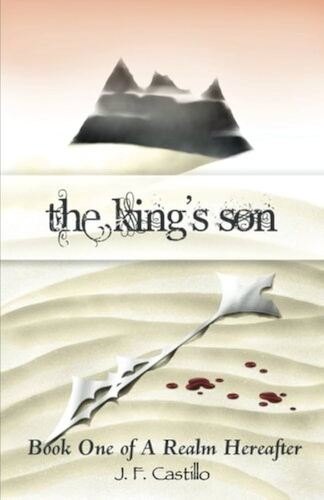
I've been meaning to get to this novel for a while, because it's by a local author and it's the start to a five-book fantasy series, 'A Realm Hereafter'. Now I've read it and its ballsy ending, after an unusual second half, I'm even more eager to see how the series unfolds; not least because an odd observation suggests that my biggest problem with the opener is addressed in its sequels. I'll get to that, I promise.
First, I should introduce you to the kingdom of Belasi. It's a violent place, it seems. We begin with another failed assassination attempt on Prince Exendrik, the third such thus far. His mother was also stabbed to death when he was eleven, although his father has lived long enough to grow old. He's transitioning power to the prince, but neither is popular. In fact, Exendrik is egged when he appears at the execution of his assassin. That's really not a good sign for someone who isn't even leading anything yet. How did he get so unpopular and is his name a homophone for "eccentric"?
While it might seem initially like this will be a tale of court intrigue, it soon becomes a quest. The Key to Belasi has been stolen from the Temple, perhaps an inside job by one of the Temple Guard, and Exendrik is promptly presented with a quest schedule by Lady Etha. He must travel to Dexper to find and enlist a thief to the cause, then to Dow Rah, then Shefer and eventually Se'en Aye, the town in which the Gate to Belasi stands, forever holding out the Bero Toc. That's what the Key to Belasi opens and it must not be allowed to do so.
You see, there's a history here that Castillo only drops hints about. This is unmistakably a fantasy world but, if I'm understanding things right, it's one built on the remnants of civilisation after an apocalyptic war. The people Belasi are descended from those who went underground into a huge bunker of a city and stayed there for however long was needed. The Bero Toc are descended from those who stayed on the surface and were thus deformed by the war or its perhaps literal fallout. When the former emerged, unscathed, the latter were jealous and were thus kept out of the land they constructed by a twenty-foot tall perimeter wall.
Exendrik jokes to a servant, Klarette, that he's going to familiarise himself with his kingdom, but, of course, that's absolutely what's going to happen. He's been cloistered through his youth. He's a decent enough guy, it seems, and he's not uneducated but he doesn't seem to have much of a clue about the kingdom he's supposed to take over or indeed the idea of governance. His talents are mostly in wielding the privileges of the privileged. He's utterly in his element when he's forced to attend a ball in Shefer.
Of course, he learns plenty on the road, using the name of Xendr, not merely about the everyday lives of the people of Belasi and how they're affected by his father's leadership, but also in sheer common sense. Avor, a trader he meets on the road, teaches him much. Fen, the thief he's meant to find, teaches him more, starting by taking him into the countryside and robbing him blind. The quest does move on though, and it gradually involves more and more characters we might expect to play a part as the series progresses: a dragon called Bartel, an old friend named Lappet and an immortal witch or sorceress by the name of Nesair, pronounced with three syllables.
There's a lot more that I'm not going to tell because it would be easy to veer into spoiler territory in this one, even though the twists and shocks don't come until the final stages and escalate until the ballsy cliffhanger ending. Now that I want to talk about but I'll have to hold my tongue until I start writing up book two, at least as far as I can presume right now. What I will say is that both of the leads, as I'm seeing Exendrik and Fen, have a secret power, which is par for the course in epic fantasy, but neither is used the way they would typically be used and the former especially could as much as a curse as a gift. It's telegraphed early in scenes that appear to make no sense but are explained much later in the book.
What I'll talk about instead is how oddly this book is structured. It's clearly dominated by its plot, suggesting that the author is a plotter not a pantser. If she's the latter, then she must have a lot of patience as she wends her way from A to Z via every letter in between. Early on, that's fine, as she sets up the story well, giving us the bedrock we need to move forward but otherwise mostly a lot of hints as to what we might encounter as we do so. She doesn't skimp on character either, as both leads are memorable. Exendrik doesn't seem like he will be at the start, just another dumb handsome prince to ignore, but he grows shockingly well. Fen is nuanced from her first moment.
What makes the structure odd is that it's epic fantasy. This is the sort of story that would take up a doorstop of a volume, the sort I'd bitch about not being broken up into multiple parts. However, it's over and done in well under three hundred pages; and the longer it runs, the more wrong that seems. An epic fantasy author for a major publisher would flesh out the first half without adding a lot of substance, because all the bones are here; they'd merely deepen the worldbuilding with an infusion of colour and texture and detail. However, they'd flesh out the second half so much that this starts to feel like a synopsis or a plot outline.
The sections here are broken up by day. The beginning is effectively a prologue, eighteen pages called "The Days Preceding". The first section is Day One and it takes up over fifty pages, as does Day Two. Day three, however, is done in thirty; Day Four in forty, because Castillo really gets her teeth into the theft part of the story; and Day Five in an astoundingly short ten. Those generally decreasing page counts are very noticeable, especially when we get to Day Five. In a typical epic fantasy, these sections would be of roughly equal length and at least a hundred pages each.
That means that the first couple of sections are perhaps too short but that's not noticeable until we start to think about this later. Like I said, all the bones are there. The plot is well defined and the characters are growing. So I don't get to know about the colour of the tile in the king's throne room? I don't particularly care. However, it's impossible not to notice how short Day Five is. What matters the most, perhaps, is whether I'm complaining about the author not doing her job or just aching to read more about what happened while the plot and characters whisked through to get precisely where they needed to go. I'd be lying if I didn't say I'm doing some of the former, but I'm definitely doing plenty of the latter too.
I'm not quitting here. I want to read on, especially after that ballsy cliffhanger ending. And so to what I hinted at as I began. My biggest problem here is absolutely not with the story, characters or anything that happens. It's that I wanted it to take a heck of a lot longer and I'm well aware of the irony in play there. Usually when I read epic fantasy, I want it to be shorter. I want to be able to lift those hefty tomes in comfort. I want the story to keep moving and the characters to keep growing. Castillo meets all those requirements but was just too quick about it.
And I wonder at this point if she realised that because this is the shortest book in a series of five. Book two is eighty pages longer. Book three isn't but it's still longer than this and books four and five are longer between them than the first three put together, the last volume racking up twice the page count of the first. Now, it could well be that Castillo simply starts to pad things out but I don't buy that. I think she just found her stride and let the words flow. Maybe she evolved from a plotter into a pantser. If that's the case, maybe if she wrote 'The King's Son' today, it would be an awful lot longer.
I'm fascinated to find out, so see you next month for 'The Dragon Queen'. ~~ Hal C F Astell
|
|