|
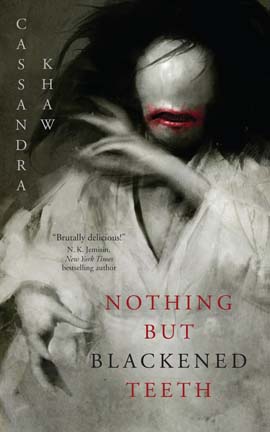
I have to confess quite a fascination for this novella, which my better half has already reviewed for the Nameless Zine and which prompted an illuminating discussion as January's choice for CASFS's Book & Media Social. It comes up a lot on the Books of Horror group on Facebook, where reaction seems to be polarised: a lot of people love it, but the rest hate it. The wife found both categories, as did the book club and, in large part, as did I. I'm generally falling on the positive side and there are aspects that I absolutely adored, but there are also aspects that I had trouble with, albeit not so much as to hate the book, as many did. I can see why.
It's a horror story, a haunted house yarn in which the house itself is the most endearing character and a story drenched in Japanese culture, even though Cassandra Khaw is Malaysian. The primary characters are the few members of a highly dysfunctional wedding party, all of whom are in their twenties and all of whom seem to have slept with or had some sort of relationship with each other.
That's such a close history to suggest that they ought to be a coherent unit, but they're not. There are still petty jealousies, unresolved traumas and outright grudges, perhaps justified ones, that temper a supposedly happy occasion and render it something of a social nightmare. It's almost a reality TV show, phrased as a horror movie. Throw in vast wealth imbalances and it's an absolute recipe for disaster. It won't get picked up for season two.
It's Talia and Faiz who are getting hitched, with Phillip officiating and financing the trip. He's rich beyond reason, billionaire rich, which means that standard economic rules just don't apply to him. If he thinks something's a good idea, he'll just do it, which is why everyone has been flown out to Japan on first class tickets where they'll all stay at this ancient haunted mansion that ought to be under protection orders and museum-level care. Also present are Lin and Cat, though they're both surprised to be there.
Cat is our narrator, potentially an unreliable one given that it takes only two pages to learn she's only just emerged from treatment for a nervous breakdown—Khaw calls it terminal ennui—which was triggered by some sort of traumatic experience at a haunted house. This is a pastime for this group, who spent years ghostchasing in Kuala Lumpur, hence the choice of wedding venue. Also as early as page two, she hears a ragged girl's voice that's whispering to her in what she believes to be a hallucination. As broken as she is, Cat is our voice of reason, the one with serious knowledge in Japanese culture, as a university student of Japanese literature.
By far the most effective aspect of the book for me was the house. We don't know what it's called, because the people who gave Phillip access to it and its grounds refused to tell him, but it was the venue for another wedding, long ago, that didn't happen because the groom never turned up. No, he didn't get cold feet, he merely died on his way there, but the bride decided on eternal passion, to wait for him at the house until his ghost finally came home. And, to sweeten the pot, as it were, she had a new girl buried in the walls every single year.
It's hardly the most original build up, but Khaw employs highly evocative language and, just as the house effectively comes alive as a character, it grows as a mystery too. Even if we have any level of background with Japanese culture, especially the concept of the yokai, the personifications of the unexplained that are everywhere in animistic belief systems, there's probably something here we don't know about and Khaw isn't interested in giving us a basic grounding in the subject. She tends to assume that we know something and so adds little details when venturing into the obscure. My background is pretty good, so I was fine with tanuki and kitsune and tengu and the rest, but those without that depth tend to be lost.
This descriptive language is another polarising factor. Khaw has a versatile vocabulary and she has a poetic talent at layering descriptions to evoke our senses while we read. It can be very daunting and it's put off many readers who DNF. More adventurous readers tend to be fine with it and they benefit from these rich descriptions because Khaw almost paints with them. The scenes when the yokai in the walls start to move are magnificently drawn. If anything, I found the description a little deliberate, though, as if Khaw had written the basic framework for the story, then added a layer of description to deepen it and then repeated that process a couple more times. It's beautiful use of language but it's very careful use of language. It didn't always flow for me.
The polarising point that I agreed with is how unsympathetic all these characters are. It seems fair to assume that we're supposed to sympathise at least somewhat with Cat, who's suffered at these hands, even if Khaw never quite explains how, but I didn't. I found her entitled and annoying, if not as entitled and annoying as everyone else. Lin has the benefit of being brutally honest, which is a breath of fresh air in this company, but he's entitled and annoying as he does so. I got round this a great deal by siding with the house. Whatever evil the supposed bride wrought here, that's not at all the fault of the building, and my sympathies went there.
As it became clearer what the house wanted and what that would mean to this new bridal party, I actually perked up. I wasn't gleeful but I was all for it and I almost felt like a giddy child who could pick out whichever puppy they liked the best. Except I was choosing someone to die. Quite how we should read this, if Khaw truly wants us to be sympathetic to these unworthy characters, I have no idea. Maybe she's with us all along and she's picturing the same reality TV show we are but spicing up the insufferable nature of the beautiful people with a little horror. Those readers who hate this book tend to call out how they didn't care about anyone but didn't transfer their allegiance to the mansion itself. They DNF.
And I think that's how best to see it. Picture this as a posh reality TV show with its inevitable set of impossibly rich and beautiful entitled people who bitch and moan about their privileged lot in life and pout at the possibility that they might not get their way about something. Then picture which of them you want to die first. If you come in with that mindset, then Khaw's poetic style might give you some satisfaction in wrecking someone else's intended good time. If you don't, then you could toss a coin. Odds are you're going to love it but the same odds are that you're going to hate it. ~~ Hal C F Astell
For more titles by Cassandra Khaw click here
|
|