|
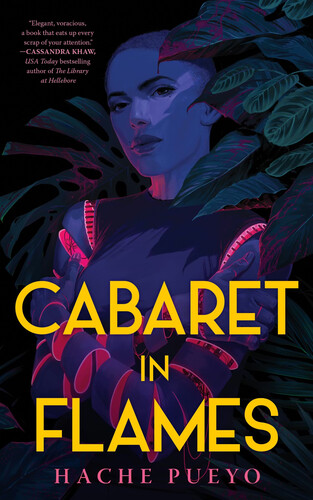
Last year, I read 'But Not Too Bold', which was a fascinating introduction to a new author. This is a completely separate story but it continues her exploration into certain themes; not least an open and romantic connection to the monstrous but also the meaning of power. Like 'But Not Too Bold', it's also a novella from TorDotCom, but this one was also expanded from a shorter work published in Brazilian Portuguese.
In many ways, this plays out like a vampire story but there are no vampires in it. Instead there are guls, the creatures we would usually spell as ghouls. They drink blood too, but they also eat bones and flesh, a diet that prompts popular culture to typically keep them a long way from the elegant depiction of most vampires. They're like vampires' messier, sloppier, more disgusting cousins. Not here though. Pueyo narrows the gap between the species considerably, giving her guls not merely slower aging but a veneer of civility and a sense of morality. Augusto and Quaint only eat the vile. Others, however, have more decadent tastes.
We meet Quaint first, when he comes to see the gul doctor, Erik Yurkov, only to find him gone. The doctor isn't a gul himself, I should add, but he treats them as a specialty. Now his apprentice does that work. She's Ariadne and she's the focal point of our story, with a name that invites a mythical reading to it, especially after we encounter Minotauro. Those names surely can't be coincidental. Does that make Quaint a version of Dionysus? That's open to debate but I didn't see it personally. Then again, it's been a while since I've dipped into Greek mythology for fun.
Anyway, Quaint and Ariadna are unusual characters. The former is a gul who's heavily tattooed, a surprising choice given that his condition actively fights the ink, making it fade away much sooner than would normally be expected. The latter is a quadruple amputee. Her time with Erik started when he fashioned new limbs for her, with artificial skin that doesn't just make them look real but capably conceals where they meet her real flesh. Our location is unusual too, because Erik's office is in Brazil, in Vitória, the capital of Espírito Santo. The backdrop is dystopian and, from the level of technology in Ariadna's prosthetics, presumably near future.
Erik serves as the MacGuffin of the story. Quaint is disappointed to find him gone but it seems he packed his bags five years earlier and left. There's clearly a mystery there but Ariadne hasn't dug into it, instead losing herself in her work. That mystery deepens when Quaint returns two months later with a key. He opens a storage area Ariadne didn't know was in Erik's office and the journals inside suggest that, while Erik left, he also returned at some point in between without telling her. And, with a teasing hint that people know what Erik did in 1972, we leave for Cabaré.
That's the cabaret of the title, a club of legend that's located in Rio de Janeiro and caters, for the most part, to what we might call the gul elite, those who might represent the peak of gul society. As to the definitions of "elite" and "peak", that's an open question and somewhere that Pueyo is able to explore what power truly means. At Cabaré, Quaint hopes to pick up Erik's trail to figure out where he went and why, but the further into that quest they go, the more a further mystery aches to be solved, that of why Ariadne needed four new limbs to begin with.
She doesn't remember. There was some sort of abuse that's become suppressed trauma. It may or may not have involved a yellow house, but that sort of glimpse is all she has, at least at this point. Now, given the context, it probably isn't a huge stretch to figure out what happened to her, but it really isn't just about the what, it's about the who and the why and, to a degree, the how and the best of us wouldn't be able to hazard guesses at any of those questions, at least until the pair of them visit Cabaré and start to stir the water.
Pueyo's romantic approach to the monstrous was easy to see in 'But Not Too Bold' and it's easy to see here too. The two characters who eventually become an item are moving in that direction as soon as the novella begins, so it isn't much of a surprise when it happens, much less so than in her previous novella. She handles it just as capably though, perhaps without as much of a focus. More attention, I would say, goes into exploring the dynamics of power, because it's everywhere in this story, even if it's often more obvious in the backdrop.
This dystopian Brazil, presumably in the near future, is drifting into dictatorship. The president is a long way away but he's obviously keen to perpetuate his rule. On a more local level, that means a curfew in the cities, but it's one that's restricted to human beings. Guls are not held to it, which in turn means that anyone going out after dark isn't just risking contact with violent cops but also potential death at the hands of a gul. When Ariadne is subject to curfew but Quaint is not, it can't help but remind us of gender inequality.
That's a reminder of the fact that, even when a situation really isn't about gender or race or any other particular demographic, all of them coalesce in the background into a look at power, at who has it and who doesn't and where the dividing line is drawn. Ariadne is legally disabled, even if she is entirely functional with her advanced prosthetics. Quaint is Chinese, his origins during the Ming dynasty, while Augusto is presumably black, his parents coming from Mali and Zimbabwe. Rafaela and Genebra are Portuguese and French respectively, both reaching Brazil during the Napoleonic Wars. We could easily equate elite guls with colonial power.
And, of course, guls have power that humans don't. They're stronger and they live longer, even if the latter comes with hidden catches. Time passes much slower for them, which is great after you become an adult but not so much if you're a child taking forever to become an adult or, horror of horrors, if you're a mother whose baby takes three years to gestate. Needless to say, just like pop culture has taught us about vampires—"You'll never grow old, Michael, and you'll never die”—it's not much of a step to see the same benefits in being a gul. This becomes a key part of the story in ways I won't explore but which you may well not see coming.
In short, there's a lot here. There's a telling note in the acknowledgements that hints at why the author seems drawn to the monstrous and I sincerely hope that writing stories like this and 'But Not Too Bold' is helping her. Given that, it seems cruel to want more along these lines, but she's a writer of clear talent, apparently in more than one language, who's bringing an unusual new take to a lineage of dark fantasy that arguably goes back to tales like 'Beauty and the Beast'. She has plenty to say along traditional lines but a deeper and different sense of theme. It's enticing. ~~ Hal C F Astell
For more titles by Hache Pueyo click here
|
|