|
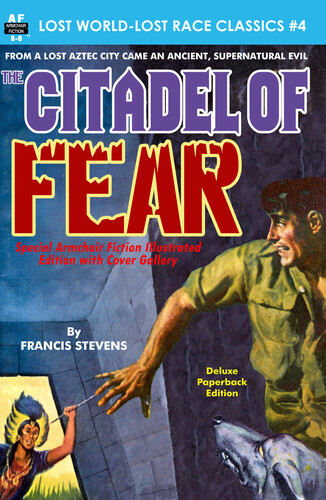
Here's a book I've been looking forward to for quite some time, since long before I discovered the 'Lost World-Lost Race Classics' series from Armchair Fiction that prompted my review. I'm reading it now because it's the fourth volume in that series, but my recent interest in Francis Stevens was sparked eight years ago when Modern Library reprinted her dystopian science fiction novel, 'The Heads of Cerberus', as part of their 'Torchbearers' series. I followed that up with her weird classic of the sea, 'Claimed' and planned to wrap up with 'The Citadel of Fear', as that was the only book of hers otherwise sitting on my shelves. However, I got distracted then so I'm reading it now.
It's a fair inclusion in the series because it begins very much as a lost world/lost race story. A pair of gold prospectors—an American veteran called Archer Kennedy and a younger Irish giant, Colin O'Hara, who he calls Boots—are seeking their fortune in Mexico. They're struggling through the Collados del Demonio, translated here as Hills of the Fiend, which is part of a remote land known as Anahuac, the heartland of Aztec Mexico, when they stumble, almost dead, into a strange oasis of civilisation. There's a plantation and a hacienda, both run by Svend Biornson, a Californian man of Norwegian parentage, and his wife Astrid.
If that sounds unusual, that's just the beginning and the curious prospectors promptly investigate the area. They find moths ten inches across and a Moth Girl too, wrapped in Opals. During a storm that rages up suddenly, there's a barrage of white ghost beasts and then men, also white and tall too, unusually so in both instances. They're promptly confined in Tlapallan, where the Moth Girl is a daughter of Quetzalcoatl. The white beasts are the hounds of Nacoc-Yaotl, creatures belonging to the Guardians of the Hills, the tall white men. Are these the reality behind the legends of white giants and ghost cougars or, as Kennedy believes, just an elaborate hoax?
Well, we soon find out, as they mount their escape, because they find themselves underground on a strange white sea, with islands and incalculable gold and gods with names as strongly daunting as Tlatlanhquetezatlipoca. Kennedy pursues the gold, finding his way into places emphatically not open to outsiders. O'Hara is more taken with Moth Girl, but accidentally stirs up a long simmering feud between the followers of Quetzalcoatl and Nacoc-Yaotl. Biornsson has been trying to stifle it for years and a marriage he's brokered might have done just that until this outside intervention.
So Bjornson gives both men to Nacoc-Yaotl and, nine chapters into the book, roughly a third of its page count, we would be forgiven for thinking that we're fully immersed in a lost world novel. The remaining pages will surely be dedicated to the adventures of Kennedy and O'Hara underground in Tlapallan fighting gods and upending civilisations and all the other fun stuff that we tend to be given in such stories. I unwisely paused at this point, which made my return the next day a jarring hallucination, because Gertrude Barrows Bennett, the woman behind the pseudonym of Francis Stevens, had something entirely different in mind and chose this point to turn on a dime.
We end chapter nine with O'Hara about to be let loose into the Anahuac desert to eventually die of dehydration, his partner pleading to join him because it's surely a kinder fate than the one he's walked himself into back in Tlapallan. Yet we begin chapter ten with O'Hara in Carpentier, a small suburb of an unnamed city in the eastern United States, visiting with his sister Cliona who's newly married to Anthony Rhodes. We're given a little explanation of how he escaped certain death but it's ancient history now. He was twenty back then. Now he's fifteen years older and all he has left from Mexico are dreamlike memories and a small statue of Quetzalcoatl that belonged to Astrid.
What's more, we appear to have shifted sideways into a completely different subgenre. It's hard to imagine a greater shift in location than from a primitive Tlapallan to the civilised Carpentier, but we're still very much in fantastic fiction, as we find when there's a break in at Cliona's by some sort of "white, frightful shadow" accompanied by a strong smell of musk. O'Hara and Rhodes are away but they return to find her lapsed into a coma, having put ten bullets into whatever strange creature limped out of there in a trail of its own blood.
Eventually, of course, these threads will weave together, because if O'Hara isn't going to return to Tlapallan, then Tlapallan will inevitably come to him. However, the way in which this happens is quintessential weird fiction. This may have been a traditional lost world novel for perhaps a third of its page count but it grows into much more. There's urban horror here that feels a lot newer in mindset than the novel's original publication date of 1918, when it was serialised in 'Argosy'. It's a story that's drenched in urgency and suspense for whole chapters at a time. It ventures into mad science, one reference to 'The Island of Dr. Moreau' not at all out of place when we find our way to Chester Reed's stock farm, with Marco, his albino servant, and Genghis Khan, his trained ape.
There's also a glorious and joyously frantic setpiece of a finalé that's reminiscent of William Hope Hodgson, whose 'The House on the Borderland' was only a decade old when this was published, as well as a foreshadow of where H. P. Lovecraft would take what would eventually become known as cosmic horror. At this point, he'd only published two short stories in an amateur publication, one pseudonymously, though he had been part of a feud in the letters column of 'Argosy' for most of a decade. There's no doubt that he read this and it clearly helped shape his own fiction.
While this was clearly an ambitious first novel, Barrows had been first published in 'Argosy' as far back as 1904, though the majority of her work dates to between 1917 and 1920. I'd call it a success but it covers so much ground that I can imagine some readers becoming confused as to the genre it falls under, especially nowadays when weird fiction is seen less as one genre in itself and more a catchall for a whole slew of them. 'Claimed' is weird fiction too but easier to label horror, and 'The Heads of Cerberus' is clearly dystopian science fiction. That only leaves one other novel, 'Avalon', which I haven't read but would seem to lean more on the gothic. It's been recently reprinted with 'Claimed' by Black Dog Books, so I should seek it out.
I should also seek out her short fiction, which was collected by the University of Nebraska Press in 2004 as 'The Nightmare and Other Tales of Dark Fantasy'. That's a label I've often seen applied to her work, as indeed she's often cited as "the woman who invented dark fantasy". She's under-read today and deserves much more attention, as a true pioneer. It appears that that 1904 story, 'The Curious Experience of Thomas Dunbar', published by G. M. Barrows, may be the first example of a credit to a female American author under her own name for a science fiction work.
Next up for 'Lost World-Lost Race Classics' is a dip back into the Victorian era for a book that I saw highlighted on Facebook recently, James de Mille's archaically titled 'A Strange Manuscript Found in a Copper Cylinder'. ~~ Hal C F Astell
For more titles by Francis Stevens click here
For more titles in the Lost World-Lost Race series click here
|
|