|
Many thanks to Ron Tobin for sending me a copy of this second book in his 'Plaz Seschni' series. He liked my review of the first, 'A Ruby for Victor', last year but we weren't likely to see each other at upcoming events because he unexpectedly moved out of state while I was writing it. That's a good reminder for me to buy books like this one when they come out instead of waiting for a time when I might have a healthier bank balance. Another is the detail that this came out in 2018 but I hadn't realised that I was listed in the acknowledgements. Thanks again, Ron!
'A Ruby for Victor' is a vampire novel, but it's an agreeably unusual one. While these vampires do some of the things we expect vampires to do—like drinking blood, healing rapidly and living much longer lives than the rest of us—his take on vampire society is as original as his take on history. It isn't the typical vampire novel; it has the species dating back to Atlantis and factoring in ideas like twin flames, reincarnation and an ancient and ongoing presence in space. That worldbuilding was arguably the best thing about the first book, the inevitable catch being that there was never going to be enough room to include everything we want to know.
The first good news about this sequel is that it adds a substantial amount of further depth to the worldbuilding, though not every question is answered by the time that it wraps. Also, while Tobin does remove some important characters from his stage, thus setting changes in motion, there are others who seem to be set up to play a part here who somehow never get around to it. I have to assume that one asshole character in particular will return to prominence in book three; if that's not the case, then he got far too much attention here than a red herring deserves.
Unlike the first book, which featured an unusual riff on the Van Helsing archetype as a serial killer of vampires, there isn't a particularly dynamic central plot. The title refers to two separate blood debts that were set up in the first book to be paid in the second and Tobin spends the majority of this book delivering on that promise.
The first is a huge one, owed by the Vitzameri to Aurea, the most prominent character in 'A Ruby for Victor', even if she wasn't its lead; he made a disastrous decision at a particularly crucial time that has adversely affected her for a couple of centuries, something that must now be addressed. The other is a lot more recent and a lot less prominent but equally as important, owed by Aurea to Victor after he saved her life in the first book from that serial killer of vampires.
That these blood debts are owed is never in doubt on any side, but the details matter immensely. Therefore, this book boils down less to the why of them, but the what, the how, the when and the where. If that suggests a talky book full of negotiations and vampire etiquette, then that's not a particularly unfair description, especially as Tobin orchestrates a neat angle to explore historical detail for us through Victor's Uncle Reggie. He's invited to Avignon to visit the Vitzameri and use his history viewer to wander through the past hundred thousand years or so. Damn, I want one of those! However, there are subplots here that spice it all up into something more dynamic.
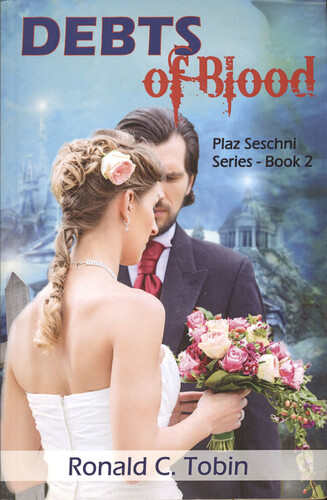
There's action through a few characters being discontent, whether on a grand or a very personal level, but willing to use violence to achieve their goals, both against humans and vampires. There is a romance, as the highly uncharacteristic cover art for a vampire novel ably suggests, as Victor and Cassie Mae grow close enough not just to sleep together but to decide to tie the knot. What traditions are invoked by that decision trawl in a surprising amount of science fiction, an angle I now have even more questions about. Even more unexpectedly, Tobin descends into porn at one point for no apparent reason and gifts us an exploitation movie angle including a bizarre pay-per-view event that must be read to be believed.
As with the first book, I'm surprised at how Tobin manages to cram so much into what's really not a huge page count. It's probably fair to think of both volumes in terms of grand family epics, with the families not necessarily dynasties but orders of vampires. Certainly, the level of change is on an epic scale, on par with something like 'Shogun', though the characterisations aren't remotely as deep. Then again, books like that are usually doorstops that unfold over a thousand pages and these two have three-hundred and change each. I'm not complaining about character depth when the worldbuilding is this rich.
What I will complain about is the dialogue. Partly, it's that it feels like first draught dialogue that an author would usually make more natural during the editing process, but mostly it's that every character sounds intensely formal all the time, a problem inherited from the first book. Victor's a young intellectual who's surely somewhere on the spectrum, so I can understand him avoiding the contractions that most of us use a dozen times a minute, but that simply doesn't apply to most of the other characters, human or vampire, whatever planet they're from.
This lack of contractions is a mild annoyance in the first book, enough so that I commented on it in my review, but it's far worse here, especially as major characters like Victor and Aurea, who speak consistently without contractions, at least initially think with them—the very first page includes a whole bunch: "It isn't glowing", "I've got to get in there!", "I'm trapped!" and "He's going to spray me with acid!"—but, over time, ditch that entirely. It isn't even consistent. I may well have woken my wife unexpectedly at three o'clock one morning by yelling "Yes!" when Jennifer shows up. She works as Victor's secretary and actually speaks like a human being.
Otherwise, there are a few approaches that I'm unsure about because they seem to be wrong but may turn out not to be, given historical and cultural norms that we haven't been fully let in on yet. For instance, this ancient vampire culture is kept as carefully secret as we might expect for books in which the species hasn't "come out" to society at large and gained legal standing. However, for vampires who routinely eliminate humans who manifest psychic ability that could later become a threat, they sure like to explain everything about themselves in intense detail to certain humans they happen to like, like Uncle Reggie. Yes, we're an ultimate secret society and you're not part of it. What do you want to know?
They hit Apollo 13 deliberately with lasers to stop mankind discovering installations on the moon but 95% of space fleet personnel routinely visiting planets fifty light years away are human? That doesn't seem to add up, but maybe they're just humans from different planets, such as Birizlana. If so, at what point did mankind collectively forget about the space programme they'd worked on since the days of Atlantis? I don't think we can blame the dark ages for that little detail. And how easily did we fall into eras like that with Order Ruby in full effect? If they weren't complicit, what did they do to haul us out again?
Talking of which, another big question mark for me is morality, but again that could well become appropriate as the series grows. Order Ruby, which we now know comprises about half of vampire culture, seems to be honourable now and in the past, with odd bad decisions like the Vitzameri's eventually addressed through the concept of blood debt. We learn here that Order Emerald also seems to have honour, at least at its highest levels, even though Order Sapphire may be looser in that regard.
However, if these vampires are generally good guys, how do we reconcile that with a tradition like ensuring that your first kill after being made vampire be of someone deserving (or willing)? That would seem to be a very modern American take on killing that doesn't gel with an ancient species which boasts individuals whose ages could be zip codes. And let's not get me started on the crazy pay-per-view, which operates with a moral compass worthy of the Marquis de Sade! That I'd adore a concept like that in a straight to video exploitation movie from the early nineties doesn't make it fit comfortably in this series.
There's so much more here that I'd love to talk about in a review, but it would quickly venture into spoiler territory so I'll avoid it. What I will call out is the last line of Tobin's acknowledgements, in which he apologises for taking six years to get this second book into print and promises that it will never happen again. The next one will arrive sooner, he guarantees. For those not keeping count, it's been seven years already and I don't believe we have book three yet... The clock is ticking and the alarm has already gone off. Hey, that's his timeframe, not mine! ~~ Hal C F Astell
For more titles by Ronald C Tobin click here
|
|