|
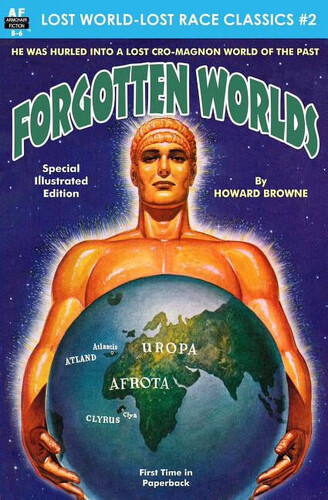
'Atlantida', the French novel from 1919 that was Armchair Fiction's selection to kick off their 'Lost World-Lost Race Classics' series of reprints, was a fascinating book. I enjoyed it a great deal but it was longer than it should have been and its narrative structure was outrageously convoluted. It's not a particularly accessible book but it's a rich and deep one. By comparison, this second volume is a good old-fashioned ripping yarn, as seems appropriate given that it originally saw publication in the May 1948 issue of the 'Fantastic Adventures' pulp.
The author is Howard Browne, who was apparently a managing editor on 'Fantastic Adventures', albeit not at this point in time. More famously, he was a managing editor on 'Amazing Stories'. In 1950, when editor Raymond A. Palmer left Ziff Davis, Browne took over both, authorising a couple of major changes to the latter. He stayed there until 1956, when he shifted to Hollywood to write screenplays for film and television. He used a number of pseudonyms over the course of his career and this was originally published under the name of Lawrence Chandler.
I didn't know about him until recently, when I reviewed 'Space Ships! Ray Guns! Martian Octopods! Interviews with Science Fiction Legends' by Richard Wolinsky. Browne was one of the legends and I followed up by listening to his fascinating interview with Richard A. Lupoff on Radio Wolinsky. I've picked up a couple of his novels, but this is the first one I've read. I'll be happily diving into others after this. It's outrageous pulp adventure in the Edgar Rice Burroughs tradition, but it's also a lot of fun. No, cancel that. It's a ridiculous amount of fun. I must have been grinning through it.
We start very much in our world. Lt. Reed McGurn, an American fighter pilot, is still over German airspace in his Spitfire, on his way back to France, when he encounters five enemy Messerschmitts who engage him in aerial battle. He shoots two of them down but, damaged, crashes into a third and they both go down. However, his plane falls through a mysterious grey cloud towards a jungle that surely isn't anywhere in Germany. His plane is wrecked, of course, but he's alive, if injured to a realistic degree, given how the trees shielded his fall. He has cigarettes, matches and a Webley service revolver, which he promptly has to use to defend himself against an attacking panther.
He either isn't in Germany any more or this is no longer 1939, probably both, and that becomes as clear as day when chapter two kicks off with Bitog, a Cro-Magnon warrior of the tribe of Mosat, in his quest for Lua, daughter of Yortok, who rejected his advances. He finds her with Azar, son of the tribal chief, Mosat, who he murders in cold blood. When Reed wakes up to find that he successfully killed the panther, he finds Bitog and Lua and steals the latter away, running back to camp. She's as beautiful as he is handsome, because this is pulp adventure, though they can't understand each other at all until he learns the language. It takes him a whole day to become relatively fluent.
If you're imagining this novel to be a Stone Age jungle adventure romance, then you're not far off the truth, but it doesn't stay in the jungle. Chapter four takes us to other characters, who are in a web of intrigue in the ancient city of Atlantis. Avar-Ak outwitted Clat-Ron, high priest, and stole a precious idol, the Golden God. He's travelling from the island of Atland to that of Clyrus, but he's a sneaky bugger and goes to Afrata itself, which is where we've spent our time thus far. Of course, a series of adventures put the Golden God into Reed and Lua's possession, along with a xorth, a cool evaporation gun. However, that just trawls them into the web of intrigue with everyone else.
This is all about the culture of Atland and its king, Ashtoth, against that of Clyrus and its immense king, Mentanek, who's closer to seven feet than six and weighs a quarter of a ton. Clyrus is poorer than Atland and they're jealous of that fact. The Golden God is a path to supremacy for them. It's a religious thing. Caught up in this conflict are a whole slew of characters, who are just as defined by who they want as who they are.
Clat-Ron wants Princess Athora, but Sar-Goth wants to marry her off to Mentanek. Athora wants Reed and so does Lua. Fargolt wants Lua as well, while Rhodia wants Fargolt. Reed wants Lua but finds himself attracted to Athora too. It's all a complex tangle of hormones that often threatens to overwhelm the politico-religious angles that hold the fate of two great cities in their grasp. In fact, there's so much here that I was shocked to turn the final page and realise that there are just two hundred of them. The contents in 'Fantastic Adventure' lists it as a 65,000 page novel.
This starts out just like an Edgar Rice Burroughs novel with its unexplainable transition from one world to another, Reed concluding halfway through that he's "in a world within a world—the first invisible and on a different plane from the second." He finds himself in a jungle, hardly a atypical location for Burroughs, and Browne treats us to local words just like ERB did: Kraga the lion, Mua the moon, Aka the lightning. I've read Burroughs pastiches by other authors, Otis Adelbert Kline the most obvious, and they play out very much like this.
However, once he shifts us to Atlantis and Clyra, the primary city on Clyrus, this starts to feel very much like a 'Flash Gordon' adventure, merely set here on Earth rather than out in the reaches of space. It's a fantasy novel with jungle savages and spears, but there are also rayguns—both huars and xorths—and both these cities could easily be alien. Just to stir up the mix more, everything is regular action until the very final scene, when we're treated to something unexplainable, rather like a religious vision. And King Mentanek reminded me of Jabba the Hutt, almost three decades early. There's a lot here and, as outrageously convenient as it all is, I adored it.
From 1911 to 1948 and then back to 1912. Next month is the only 'Lost World-Lost Race' inclusion I haven't only read but already reviewed here at the Nameless Zine. However, I have absolutely no problem diving back into Sir Arthur Conan Doyle's classic 'The Lost World' again to preserve a flow for this series. The only other one that should have sat alongside it is H. Rider Haggard's 'She', an equally pivotal novel that I read for review but, for some reason, never got round to writing up. ~~ Hal C F Astell
For more titles in the Lost World-Lost Race series click here
|
|