|
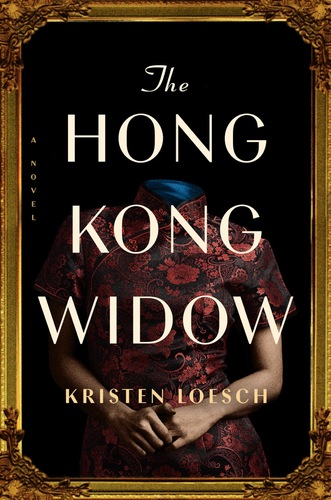
This historical horror novel slowed down my reading this month, but that's not a bad thing. It just isn't a book to read quickly, because it has so many twists and turns that we need to step away, at a regular frequency, to think about what we've just read before diving right back in. As historical horror, it's a puzzle box of a novel and the mysteries end up impressing more than the horror, one or two notably creepy scenes aside. We learn quickly that we can't take anyone or anything in this book for granted, not just because they might keep secrets but because they may not be who they say they are and, in fact, may not even be alive.
We alternate between three primary timelines with the occasional diversion into others. We start in Seattle in 2015, where Susanna Thornton, an award-winning author of narrative non-fiction, has lost her second husband and is diving into a new project to deflect from that, namely the mystery of Maidenhair House in Hong Kong in 1953. Then we shift to Kowloon in 1953 to build towards that mystery by learning about Chen Mei, initially a sales assistant in a curio shop but also a powerful medium who's invited to Maidenhair House to take part in a special series of séances. And we go all the way back to 1937, when Mei is given away by her family to another and naturally struggles with the whole idea of that, at least until she meets George Maidenhair.
There's a lot there to think about already there, but that's just scratching the surface. For a start, I should point out that there's a consistent character across all three timelines, because Chen Mei is also Susanna's mother. When Susanna decides to travel to Hong Kong for research, Ma decides to go with her and she isn't the sort of character to say no to. I felt Susanna was blah right from the outset, but I like the eighty-five-year-old Mei even more than I like her independent younger selves, in 1937, 1942 and 1953.
And she's very likable in each of her timelines, even if a lot of people don't like her. In 2015, she's a dynamo of an old lady who wants to get to the bottom of a mystery she was part of. In particular, she wants Susanna to find out why she remembers being attacked but from the perspective of her attacker, which is a heck of a tease early in a puzzle of a novel like this. In 1937, she learns that she sees ghosts, starting in the house that she's moved into, and, moving into 1942, with a young man named Max Friedman, she fosters that talent, focusing it and mastering her craft. Her particular way of handling seances is to be possessed by the spirit who draws a message before departing.
And, of course, in 1953, she's invited by Holly Zhang to take part in a series of séances to be held at Maidenhair House. There will be six séances over six nights, conducted by each of six mediums. At the end of each evening, one medium will leave, in a past echo of a reality TV show. And, when the last medium survives, they'll perform an exorcism and receive what is described as "a staggering monetary reward". Mei has moved on from this sort of thing, but is also nursing a powerful thirst for revenge against George Maidenhair; so agrees so that she'll have the opportunity to fulfil it.
Ghosts and séances and exorcisms suggests horror and that's certainly present here. In Shanghai in 1937, Mei interacts with the ghost of a girl in the attic who only has half a tongue. She meets a number of characters from earlier in the story and doesn't immediately understand that they're now dead. It takes a while for her to realise she has the sight. The séances tend to finish in death rather than a character exiting stage left, some of them particularly gruesome. And they feature horrific scenes as often as not, whether Mei has drawn them in a trance state or whether they're right there, like whatever wants out of the lake to visit the second séance, outside in a pavilion.
However, the mystery angle works even better for me. One tease I haven't mentioned yet is that someone is sending letters to survivors of the "massacre" at Maidenhair House in 1953 to return in 2015. They're anonymous, of course. Susanna receives one that suggests that her mother killed them all. When they get to Hong Kong, they find former DCI Ryan Li there too, who had attended the scene in 1953. His letter is a confession from the murderer. Leisch does deliver answers to all the questions we have, or at least all the ones I have right now. Others may pop up in my brain at a later date. She also explains most of the many other mysteries I haven't even mentioned.
In fact, while there's so much here that it could easily dazzle us away from missing answers or even flaws, I only caught one. There's a hidden room in Maidenhair House, which doesn't surprise, but it is found and opened, by virtue of at least one wall being paper. However, soon afterwards, one of the characters is apparently locked inside that room and I fail to understand how, without calling in builders to replace that ripped paper wall with something more substantial. Needless to say, it doesn't happen, so that feels like a goof.
The third angle, which works best of all, is the historical one. As much as there are stories spun in various directions away from her, this is a history of a character, Chen Mei, and the history of the world she manouevres her way through. If we shuffle the timelines into chronological order, she's initially a young child in Jiangsu Province, China, whose mother has vanished and whose father is willing to put her on a train to go live with Uncle in Shanghai. Uncle isn't her uncle, just a term of respect, just as his wives don't use names, just First, Second, Third and Fourth Wives. Mei isn't at all happy in this household and rebels against its authority over her.
Also, 1937 is wartime, as the Japanese have occupied parts of China and bombings are happening in Shanghai when she arrives. Mei is part of one of them, which prompts as horrific a scene as any of the moments of deliberate horror, but she survives. After meeting Max, she ends up with him for a while in Hong Kew, a Jewish ghetto, that point being during the Second World War. 1953 sees her back in Shanghai, working at Volkov's Curio Shop, until Holly Zhang arrives to invite her to the main attraction of the book, as it were, the six séances at Maidenhair Hall.
None of that historical backdrop constitutes a spoiler, though every moment of that and more is further detail in the characterisation of Chen Mei, which is deep and insightful. Kristen Loesch is American, I believe, who grew up in San Francisco. However, she has a master's degree in Slavonic Studies from the University of Cambridge in the UK, and she lives in Switzerland. She seems to be eager to dive into history for all her books, which touch on different parts of the world. She must have done substantial research to be able to draw China and Hong Kong this well in multiple eras. Of course, I wasn't there in any of them, so have to trust her accuracy, but it's very believable.
I also have to praise her intricacy, because this isn't a book that was simply written. I'd prefer the word "crafted", because it's got more mysteries and revelations than your average shelf of cozy mysteries. I take notes when I read, so as to write better reviews, and my notes for this one were unusual in that they got more frequent the further I read. Most are outrageous spoilers, so I left them as notes, but helped to keep the nuance of these revelations in my head along with a more general thrust of story. It's intricate enough to need that.
The last thing I'll mention isn't about Loesch at all, but about Jiksun Cheung, who drew the many images we see in the book that were, in the story, produced by Mei while in a trance state during a séance. They're a neatly creepy addition to the book that could have felt gimmicky but doesn't. Loesch describes them anyway, of course, but having them right there in front of our eyes helps a reader like me with aphantasia. ~~ Hal C F Astell
|
|