|
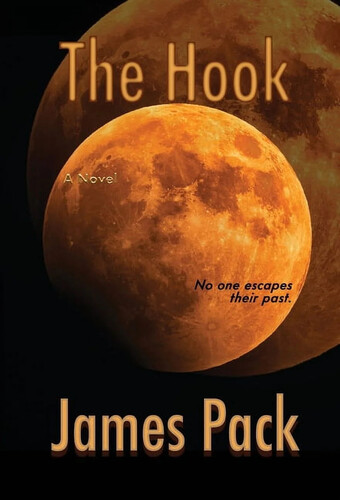
Here's an interesting horror thriller from Tucson-based James Pack, who I presume is not the hero of the same name in a series of shapeshifter smut novellas by Lacey Thorn. There's a lot of good to talk about here and it mostly ties to character, dialogue and writing style. There's also some bad, but that's far more to do with the production rather than the writing, this trade paperback falling into many traps I see all too often with self-published authors. When the best things about a book revolve around what it says and the worst things revolve around what it looks like, then it's surely ripe for a fresh edition that's been professionally produced, maybe by a reputable small press.
The good dialogue starts at the very outset, amidst a good setup full of bullfrogs and death. Out on Outlet Road on the way to Hallowell, a couple stumble on a horrific scene. It's the wife of Willie Evans and their youngest son, both dead, but obviously not in a traffic accident because someone pulled the unborn baby out of Sarah's body before they left, and took it with them. Now, I have to say that it's ballsy to set a horror novel in Maine, given that that's a rather famous author's well-mined turf, but Pack does a decent job of doing something new with the place, and this is a strong start.
There are two stories here that eventually merge into one. That removed baby ties to one, while the other manifests through Ernest Kemp, who's new in town; a Vietnam veteran seeking his wife and daughter, Linda and Amy. They're all from California on the opposite corner of the nation but the trail has led him here to the Hook, which is Hallowell Hook, just south of Augusta, Maine, thus a place just like 'The Slab' was a place in fellow Arizona author Jeffrey J. Mariotte's novel of that name. Ernie has very little to go on, just that he arrived home from a two-year tour in Cambodia to find them gone without much explanation. All he knows is that Linda needed to get away from family, not why.
We're in 1976, as demonstrated not just by the presidential race between Carter and Ford but by the ridiculous but entirely accurate amount of smoking. Hallowell is insular, the locals polite but firmly in the habit of blaming outsiders when bad things happen. Showing up as babies are stolen and sacrificed under the full moon certainly doesn't help Ernie get them to open up about where his missing family might be. He finds few allies, the primary ones being Joe, a Second World War vet who gives him a job in his general store, and Samantha Belcher, a reporter for the Kennebec Journal, whose narrative style is rather like that of Carl Kolchak.
We're only thirty pages in here but two things are obvious this early. One is that Pack is a careful writer who's setting plenty of things in motion. He's introduced worthy primary characters, set a strong sense of place and built a mystery. What's going on with Linda? Why are there ravens and bullfrogs everywhere? And who are the three women who show up everywhere, standing out like beacons only to be unremembered by almost everyone once they've left? The other is that he's a self-published author who's making all the usual self-published mistakes.
I'll get those out of the way now, so I can move onto the good stuff. The text isn't justified. There are frequent spelling mistakes but usually of the sort that aren't caught by a spellchecker, things like "where" for "were", "descent for decent" and "rabid" for "rapid". I rather liked that one and am now trying picture "rabid fire". Oddly, there's a repeated use of "sherriff" with two Rs, which ought to have been caught in spellcheck. The quotes are smart but the apostrophes are often the wrong way round. There are also sections with Ernie thinking, either internally or aloud, that are shown just like any other dialogue. They'd be far better differentiated as thoughts in italics.
But I'll shut up about the production and get back to the story. The only negative I can throw out is that it's pretty clear from the back cover blurb and the opening chapters that the three women nobody remembers are witches and they're conducting ritual sacrifices in the river presumably to extend their lifespans. Even saying that now feels like a spoiler, but it's completely obvious from a very early point so it really isn't. For the longest time, I felt like that ought to be a surprise and it was telegraphed far too soon, but then Pack sprung some real surprises on me that I was utterly not expecting and I ditched that objection sharpish. The big surprise is an absolute peach and it's handled perfectly.
While the dialogue was an early highlight and it remains so throughout, Ernie gradually took over for me as the biggest success of the book. He's a wonderful character, flawed but a good man who served his country. Some locals, playing into a fair sentiment of the time, call him a murderer not just because he's an easy scapegoat for the deaths happening in town but because he was in Nam. It doesn't matter that he was mostly in Cambodia but it does matter that he was a medic. He was there to save lives, not to take them. Such insults don't help his PTSD. We suspect that long before he reacts traumatically to fireworks on New Year's Eve. He likes quiet now, no crowds, and we feel for him.
I'm not going to provide spoilers but I will say that one crucial mystery is solved at the end of part one, which is just shy of a hundred pages in, so a third of the way through. However, it's solved in a clever way that doesn't actually answer many questions. Those abide and there's a lot of excellent writing here covering characters asking those questions and others not answering them for good reasons that we may or may not figure out before we're eventually told. Similarly, while we know early that the three women are witches, there are depths to them that we're only gradually let in on as the novel unfolds. Even when we think we know what's going on, Pack is always a step ahead of us teasing something we haven't figured out yet.
I can't talk about the big surprise, for obvious reasons, but I'll happily talk a little about the final scenes without venturing into spoiler territory. While the very end of the ending is maybe a little quicker than it could be, I thoroughly enjoyed how Pack wrote these final scenes. They're told in a sequence of flashes, especially appropriate given Ernie's PTSD, and that's a very tricky approach indeed for an author to take, but he handles fragmentation with aplomb. I was reminded here of an earlier line from Ernie: "I survived the war. I think I can handle Maine."
I believe this may be James Pack's only novel, though 'The Tommy Gun' may well be another. Most of the books he has out look like collections of short stories or especially poetry. That's surprising to me because he didn't leap out at me here like a poet. Sure, there's a lot of careful writing but it impressed me more from the standpoint of plotting than vocabulary. There's nothing wrong with the latter, I should emphasise, but usually when I read prose by poets the vocabulary stands out a lot more. I have 'The Tommy Gun' on the shelf and 'The Morbid Museum', so should dive in soon. ~~ Hal C F Astell
|
|