|
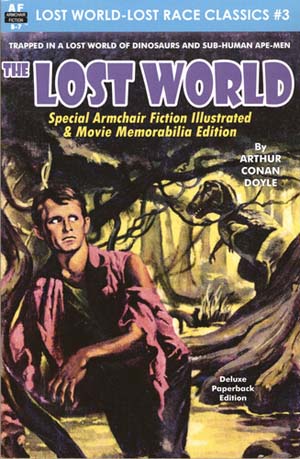
Of the entire 'Lost World-Lost Race Classics' series from Armchair Press, which I believe is up to at least sixty-six titles now, this is the only one that I've previously reviewed at the Nameless Zine. I have no problem diving back into it, especially given that I reviewed the groundbreaking feature film adaptation last February for its centennial. The screenplay is pretty fresh in mind so I was up for reminding myself how far it departed from the original novel.
The framework of it is pretty consistent. Prof. George Edward Challenger has returned to London from a trip into uncharted country in South America. He causes a stir at the Zoological Institute by claiming a monumental discovery: of a remote, unexplored plateau on which prehistoric life still thrives. Unfortunately, all his notes and samples were lost on the journey home, so the audience jeers him mercilessly, but he manages to get a return expedition arranged with both antagonistic and independent witnesses to verify his story.
The antagonistic witness is Prof. Summerlee, who's sixty-six years old but, as we soon discover, has kept himself in a condition that knows no fatigue. There are two independents, Lord John Roxton, an explorer and sportsman twenty years younger but respected by all, and Edward Malone, who's a reporter for the 'Daily Gazette' and simply wants to impress Gladys, the girl he wants to marry. She wants a specific sort of man and Ned apparently isn't it. She wants a man of danger, a natural hero. And so he decides to do something dangerous and heroic. Then again, he was a rugby player for the London Irish who might be called up for the Irish national time. In 1912, that was tough.
So off they go, without the character of Paula, daughter of the discoverer of this plateau, Maple White, because she was invented for the 1925 movie. They hire a bunch of locals to support their expedition and they're of agreeably mixed races. Then again, Roxton is known down there as the Red Chief, after he took down Pedro Lopez's notorious network of slavers. He's well-known there and well-liked and he's fluent in Lingoa Geral, the local language that's two-thirds Indian and one-third Portuguese.
My first surprise is how long it takes them to reach the plateau. This edition runs a breath under two hundred pages. Prehistoric life doesn't show up until page eighty-eight, when a pterodactyl steals their ajouti lunch, and they don't reach Maple White Land proper until page one hundred and three. The first actual dinosaurs show up just a few pages later, in the form of a family of five iguanadons. By that point, they're apparently trapped in Maple White Land, as one of the locals has a grudge against Roxton and cruelly removes the felled beech tree that served as a bridge. I forgot that detail, as the 1925 feature had a brontosaurus do that.
In my review of that film, I praised the first half as magic cinema but called out the poor script for dropping the ball in the second half. Now I realise how little it resembled the novel, which is a lot more fun, far more action-packed and without anywhere near as many clichés. Oddly, there's not as much dinosaur action as I remembered, although there is a pteranodon swamp; a lake, which Malone names Lake Gladys, that boasts ichthyosaurs; and even an ostrich-like phororachus. What we get instead is a full-on war between men and ape-men, in which our heroes play a crucial part.
As I pointed out in my previous review, this really has everything an adventure story needs, which is why it gave its name to a genre, even though it was certainly not the first example of it in print. It's the earliest of the first three books in the 'Lost World-Lost Race Classics' series, but James de Mille's 'A Strange Manuscript Found in a Copper Cylinder' is coming up in two books time and that dates back to the nineteenth century, as do plenty of others further down the list. Notably, it was published seven years before Pierre Benoit's 'Atlantida' but is outrageously more accessible with its more straightforward language and straight down to business adventure.
In fact, the language is even called out within the story. This reads like a novel, which of course it was, but its conceit is that it's really the collected reports that Malone sent back to the 'Gazette' for future publication. He was writing for a general audience. At one point, he mentions Roxton's "short, strong sentences" and, once they're back in London for the finalé, he upbraids a colleague for his verbosity. He's reading a report of the : "Oh, brother scribe Macdona, what a monstrous opening sentence!"
Perhaps this is one reason why Malone is the central character, even though this is known as the first book in the 'Professor Challenger' series. He's the everyman who connects us to the boffins like Challenger and Summerlee. Roxton would be the typical lead in many takes on this, straight from the Rider Haggard tradition, but he's a supporting character here, even if he leads his own parts of the story, especially the welcome twist at the end. Oh, and the proof at the end, for any man who still doesn't believe, is a live pteranodon that Challenger brings to the presentation at the Zoological Institute, rather than the live brontosaurus roaming the streets of London that we get in the 1925 movie.
I mention the movie again because this Armchair Fiction edition also serves as an "illustrated and movie memorabilia edition", which means that we don't just get drawings at appropriate points within the story but a selection of covers from early paperback editions, some of which I own, and some posters from the 1925 and 1960 feature film adaptations, both of which I've reviewed.
Next month, join me for the 1918 novel 'The Citadel of Fear' by Francis Stevens, the pseudonym of Gertrude Barrows Bennett, the first female author in the 'Lost World-Lost Race Classics' series. I haven't read this one but I have read, enjoyed and reviewed two later novels of hers, 'The Heads of Cerberus', which was recently reprinted as part of Modern Library's 'Torchbearers' series, and the wonderful weird sea story, 'Claimed', which clearly influenced H. P. Lovecraft. ~~ Hal C F Astell
For more in the Lost World-Lost Race series click here
For more titles by Arthur Conan Doyle click here
|
|