|
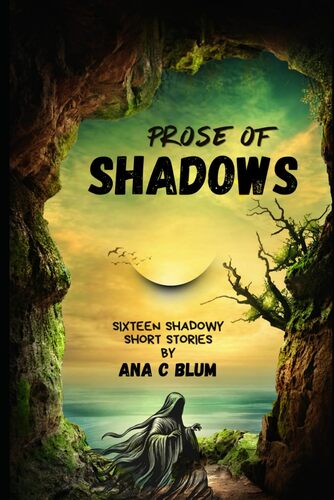
I met a delightful lady at TusCon in November, who was kind enough to buy one of my books. After she did so, one of the people she was with whispered to me that it was the first book she'd bought in the English language. Ever. That's quite the honour and I was happy to return the favour, when I saw this collection of short stories online. She dreamed them up in her native Spanish, but used a set of virtual tools and artificial intelligence to translate them into English, which is very topical.
I don't need to argue for or against the use of AI here, but this would seem to be a useful take on what it can do. She wrote the stories herself, without using anything generative, so this is clearly original creative work. However, while she has enough English to hold a conversation, words don't come as naturally to her in English as they do in Spanish, so it makes sense for her to use tools to allow her to finesse that translation. I've certainly benefitted from Google Translate when trying to translate French or Croatian subtitles to English for short films I want to screen, but it's still an uphill struggle to capture nuance.
One detail that probably helps is that they're not long stories at all. The font size is large and the sixteen stories are over in only twenty-five pages. They don't have strict word count limits that I can tell, so they aren't drabbles or another similar form. They're just short, with the approach of a poet as much as a short story writer. That may make the digital collaboration even tougher, but there's no slop here. I get the impression that she wrote her Spanish, let the tools translate, then used her English to polish and finesse, so her meaning wasn't lost and her nuance was preserved.
As none of the stories are long, I wasn't expecting them to be deep, but Blum does a heck of a lot with a heck of a little here, doing a poet's job more than a short story writer's. I don't there was a single name dropped anywhere in these sixteen stories. They're never quite that personal. This is prose poetry, subversive, transformative and collaborative. The characters are rarely alone, even when they're on their own. And there are themes more than plots, making the stories glimpses of ideas, moments or mindsets.
For instance, 'Shadow' starts us off with a frisson of discomfort. Something cold walks inside your blood, "a stain of winter ink", and it gradually steals you away. This is a glimpse of a nightmare, a shiver of fear. Not all these stories are horror, though fear is certainly an abiding theme. 'Skin in the Bottle' is another glimpse, this time of madness, as a young woman despairs that her skin will shed and scatter aimlessly, so collects it fanatically under glass, as if not to lose her ownself. 'The Steel Grandmother' explores the fear of inability. A granny sees an exoskeleton on the TV. "She dispatched her wealth across oceans, summoning the suit to her doorstep", but gets drunk on her new assisted vitality with tragic results.
While Blum is young, old age is another theme. 'Stayin' Alive' features a ninety-nine-year-old ham operator who may have "tampered with celestial circuitry". 'The Woman of the Houses' tells of a life summed up in buildings, which carries an inherent sadness to it. In a sorority house, she's the only one who sees a ghost, who "half a century earlier, had cut her wrist for love." Later, she waits in a large house by the mountains "for children who never arrived." Wherever you go, there you are. I'm not sure how old the characters in 'A Manual for the Virtuous Dead' are but they struggle to deal with the new situation. Once again, poetic phrasing stands out. They know a café because its soft blue lamp "had unveiled them each afternoon".
Following on from 'The Steel Grandmother' in a different way, there's a theme of disability too, a theme that doesn't necessarily rely on age. In 'The Chair', an unusually hopeful piece, a wheelchair unilaterally seeks a new life. In 'Spines', Blum tackles body horror in capsule form, as contagious scoliosis. A curved spine wants you! There's plenty of body horror here, some of it as pure as I've seen because it's so fleeting. 'The Gallery of Hands' sees a man become a living work of art when limbs start to sprout from his body. 'The Hug of the Moon Witch' returns to consumption by some other form, this time the merging being with nature.
Other stories find their own paths. 'Cardboard Appearances' explores all human life, translated into boxes. It's very brief, especially given the scale, but fascinating nonetheless. 'The Library of the Monsoon Poets' is content to look at the poetic call of the rain. It's as lyrical as this book gets and so it's even closer to prose poetry as we might traditionally expect it. 'Entropy in Technicolor' and 'Them' are almost echoes of each other, their consecutive placement surely not an accident. The former personifies an inchoate trickster, a force for chaos. The latter takes a different form and embraces a broader scale.
And that leaves my favourite two stories, though I'm very fond of many of those I've covered thus far. 'Continuity' is another glimpse, but this time into a rogue archivist thief who gives new life to forgotten objects. I adore the idea of this and would love to see it expanded into something long and more substantial. And 'The Curse of Language' is a beautiful curse. This piece tackles one of the biggest questions for any writer, the art of creation, equating writer with magician, just like Alan Moore has argued. Again, it's poetry in the form of prose even if it isn't prose poetry.
This would be a success of a book had it been written by someone whose native tongue is English. It's even more of a success given that it isn't, because Ana Blum surely thinks in Spanish and tries to echo those thoughts in translation. The biggest problem most readers might have with it isn't anything to do with its content but to do with its size. It's a very thin volume, which is accordingly priced—I picked up my copy at Amazon for a measly five bucks—and its stories follow suit as well. Many take up less than a page and a few sprawl onto a second, while only 'Stayin' Alive' makes it all the way to three.
I'd like to read more and at a more substantial length, but maybe that can't happen until Blum is either comfortable enough to write in English directly or willing to write in Spanish and employ a translator she trusts to shift it into English without losing its poetry. ~~ Hal C F Astell
|
|