|
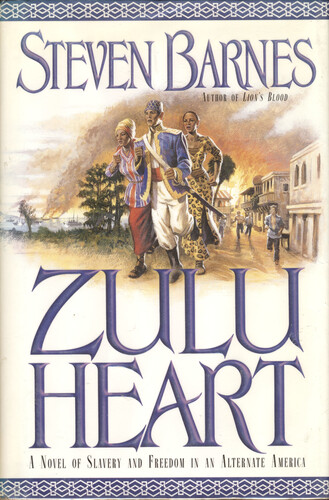
'Lion's Blood', the first half of Steven Barnes's 'Insh'Allah' duology was such a deep dive into race reversal in an alternate 19th century deepsouth that I fell into the story. It felt to follow up with the second half, 'Zulu Heart', and there will be a notable gap next month without a third volume. Instead, I'll be diving into a 'Star Wars: Clone Wars' novel, which will feel very different.
This book is set three years after 'Lion's Blood' and things have stabilised somewhat for the main characters, if not for the world that they live in. Kai is still Wakil of Dar Kush and he's still married to Lamiya; they now have two daughters, Azinza and Aliyah, though the former is Malik's. While it takes us a while to get to them, Aidan and Sophia are further north, building a new crannog with a collection of other freed slaves. Life is much better for them, as hard as they have to work, but the disparity between the races is still apparent every time they go to town to trade.
It's the world around them that's changing and it's changing fast. For one thing, what we know as the industrial revolution is starting. Many doubt the creations of inventors like Maputo Kokossa, but Kai is forward looking enough to become his patron. And war may be coming, waged between the two world powers of Egypt and Abyssinia, pitting Pharaoh against Empress. As a colony in the new world, Bilalistan doesn't want to be dragged into that but ships are massing at the harbours of the Brown Nile (i.e. the Mississippi) and it may not have a choice.
The MacGuffin of the book is a coded message that finds its way into Kai's possession in the early chapters. It's clearly immensely important and may change everything, but it's also written in an apparently unbreakable code of Egyptian hieroglyphs. This becomes an ace that he has to be very careful about playing, at least until he can find a way to steal the encryption machine from under the Caliph's nose and decode the message. To accomplish that, he eventually realises that he will have to enlist his old friend Aidan and ask him an impossible task, to play a slave once more. Why that may just happen is that he meets Admiral Amon bin Jeffar in Radama, the Bilali capital, and surely recognises his white slave girl as Aidan's long list sister Nessa.
I'm sure you're already counting the scenarios here. We're in a relatively stable alternate south here, though there are underlying tensions between black colonists and both native tribes and a powerful Aztec empire, not to forget those within Bilalistan between Muslims and Zulus. There's anti-slavery sentiment in the north, but the economy of the south is utterly reliant on slavery. If that wasn't enough,there are rumblings about war and whether Bilalistan should fight or secede. Suddenly Aidan's struggles to remain free and independent when a single black woman can state that he touched her in passing and thus generate a lynch mob seem exquisitely simple.
However, Barnes isn't interested in playing this simply. One major plot strand not resolved in the first book is the marriage of Nandi kaSenzangakhona, daughter of the Zulu warrior Cetshwayo, to Kai. That he since married to Lamiya doesn't matter at all, because the Prophet never prohibited multiple wives. Cetshwayo takes an opportunity to push this second marriage forward. Kai has no idea whether he knows that his brother, Shaka Zulu, killed Kai's, the former Wakil Ali, and that he in turn revenged his brother's death by killing Shaka. Is this an alliance between peoples or a plot for revenge?
It's also clear that Fodjour Berhar, a neighbour and childhood friend of Kai's is notably jealous of Aidan, even though he's frequently in Dar Kush as a welcomed guest while the Irishman is three years gone. When Aidan returns, albeit to train intensely so as to fight and defeat the champion of the Caliph's and thus gain an invitation to his palace, Fodjour's jealousy simmers. What's more, he has a mother, Allahbas, who has delusions of grandeur and the plans to accomplish them. Is he weak enough to be turned to her will or strong enough to resist his own mother?
'Lion's Blood' was smooth but this is smoother. There are no slow points this time out and I found the pages practically turning themselves. It's also simpler, even though there are complexities at every turn and Barnes throws in a number of twists and surprises to keep the plot from becoming too predictable. Those twists are in moments while the broader story arc contains much more of an inevitability. A river running down a mountain will always reach the bottom, even if it doesn't follow the path we might expect.
The biggest surprise for me is in how powerful the female characters are, something that wasn't the case at all in 'Lion's Blood'. Sure, the two leads are still male and both Kai and Aidan are well drawn characters with wars raging within them; Kai's internal war being between the influences of his father and his uncle and Aidan's between the future of his crannog and his long ago promise to his sister. However, many of the pivotal characters this time out are female, even though the two I'd have thought most likely to gain importance after 'Lion's Blood', Aidan's wife Sophia and Kai's sister Elenya, are minimised instead.
Nandi is a particularly dangerous wildcard, aching to usurp Lamiya to become Kai's first wife, and of course very possibly marrying him to kill him, something she's clearly capable of doing. Lamiya herself has grown immensely in three years, becoming almost as important an advisor as his old teacher Babatunde. Allahdos has almost as much potential to stir things up as Nandi, while Chifi does the same on a grander scale, as the daughter of and real genius behind Maputo Kokossa's inventions. There's a bevy of female Dahomy warriors, led by the twins Yala and Ganne, who have impressed Kai enough to hire them. Even the wife of the Caliph has a lot more balls than he does.
This is still a man's world, but it's also a black's world and a slaver's world and all those absolutes are starting, albeit tentatively, to change. That's perhaps why I enjoyed this more than the prior book. 'Lion's Blood' may be a better work and it's certainly less predictable and more brutal, but this is more enjoyable and a good part of that may be that there's a palpable sense of hope, that things are moving forward and can and perhaps are destined to get better. It won't be quick but change is coming. After all, Kai is surely the most progressive black man in the novel and he ends it still owning a whole bundle of slaves.
However, he sees a different future. The final chapter includes some massively powerful writing that's personified in him. "The Dahomy ... were not as he had been taught women were. But they were women, and that changed his view of all women. Aidan was not as he had been taught whites were. And that changed his views of all whites." Those are important words to remember as this alternate history ends and to translate to our very real history, especially in a troubled time like now when so much focus is on division instead of alliance. ~~ Hal C F Astell
For more titles by Steven Barnes click here
|
|