|
Earlier volumes of 'Akira' have been much easier to review than this one, even the ones where not much actually happens in the sense of a synopsis. Katsuhiro Otomo had just as much fun, probably even more, drawing this series as he did writing it, resulting in long sequences where a relatively simple story progression unfolds over a sizeable page count where vast and detailed architecture is just as crucial in the background as the action in the foreground. He also builds character with a dedicated focus, the numbers in particular growing substantially with each volume.
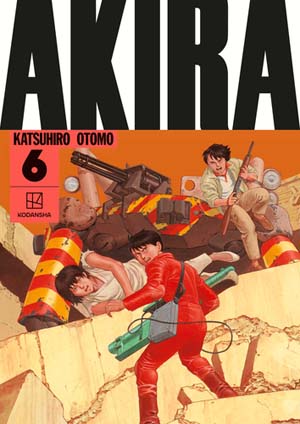
This sixth and final volume is a momentous one, probably the best of the series, but much more in the sense of story happens and a whole swathe of that would count as spoilers, so I have to be very careful about what I talk about, especially as the end here isn't just the end to this volume but the entire series. Everything has been leading up to this point. Fortunately, there's plenty left for me to talk about and, once again, as much of that has to do with Otomo's artwork as his writing.
As we begin, attack is very much the order of the day. Kaneda and the biker gang is attacking the Olympic stadium. Yamada and the elite American squad are doing exactly the same thing, but the two are not doing it together. That extends to the colonel, who's regained access to the SOL space laser and has every intention of using it. Oh, and Kei is still there as well, serving as a channel for Lady Miyako, who is thus involved psychically. The reason they're attacking is Tetsuo, who's losing control of his powers in absolutely fascinating fashion.
He transforms here in outrageous ways. His body jettisons his artificial arm as it grows a new one of his own. When attacked, he balloons up to insane size, grotesquely deformed like an immense melting baby. While the story is fundamentally science fiction, nobody's ever going to read these pages and not see whole sequences of body horror. He constantly loses control of his body, flesh erupting and morphing and transforming at serious scale, only to regain control again and shrink back down to recognisable form. Rinse and repeat.
The Americans aren't just in the stadium either. They start carpet bombing the city, which makes everyone's attacks suddenly turn into defences and evasive manoeuvres, too. Nobody's happy but Tetsuo takes it personally, flying up to a new SOL called Floyd and drops it on the American fleet. That's a glorious sequence and I could rave about it, but, quite frankly, it's one of many here and I couldn't tell you with a clear conscience that it's the biggest or the best.
While there's certainly room for the individual here, various characters getting their moments in the spotlight to expand or wrap up their story arcs, the scale here is utterly outrageous, even for this series, which has now blown up Neo Tokyo twice and taken a serious chunk out of the moon. It gets bigger and bigger in a whole slew of directions, until it suddenly goes tiny, all the way down to the atomic level. That's new and it's thoroughly important because it gives us background.
The focal point this time out is Kaneda; he learns a lot here and we learn a lot by watching him. If it wasn't clear already by this point that Otomo wants to end this in as fleshed out a fashion as he can, it's clear now. Some of the scenes here, with Kaneda and Tetsuo predate anything we've seen from them anywhere else in the series. What they recount serves as wonderful groundwork for a relationship that's at the heart of everything in 'Akira'. Talking of Akira, it makes sense that this series is named for him, but he's still been almost unimaginably passive for most of it. He doesn't change inappropriately here but he does get something to do for once.
And then there's the ending, which I can't talk about but want to. I guess I can only say that I liked it a lot. I've wondered for a long while how it would end, given that destruction has been the most common factor throughout, not merely applied to the city itself but to those who continue to live there and the factions that they form. Finding an ending that actually works as an ending for the city as much as the series and yet can also serve as a beginning for the city was never going to be an easy task but Otomo accomplishes it far easier than I ever expected.
I've had an absolute blast reading this legendary manga for the first time and can now go back to the animated movie, which I have seen before and more than once but not for at least a couple of decades. It was co-written and directed by the manga's writer and artist, Katsuhiro Otomo, so it's as official as it gets, but it came out in 1988, a couple of years before the manga was completed; it was originally serialised in 'Young Magazine' from 1982 to 1990 and collected into tankobon books from 1984 to 1993. Suffice it to say that, at twenty-five hundred pages, there's a lot here that isn't in the movie. With this new grounding, I'm eager to see how it plays on a fresh viewing. ~~ Hal C F Astell
For more titles by Katsuhiro Otomo click here
|
|