|
My first surprise here was that I don't believe I've ever read 'The Black Fedora', which is a strange admission given that it's a pretty big one within Guy N. Smith's bibliography. I thought I had, but I don't remember any of this and it's not a lesser book that I might have forgotten entirely. I recall parts of his next book, 'The Resurrected', pretty well and the Zebra books that came after it. And, around then, I laid a few books out for Guy's new Black Hill Books imprints. It was the time when I was reading him most avidly. So how did I either miss or forget this one?
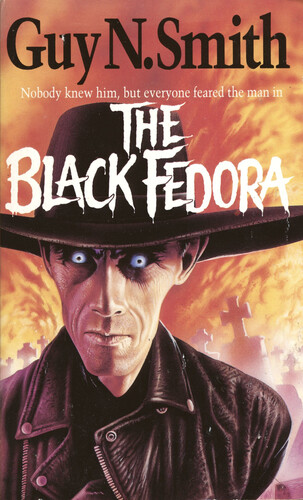
It isn't a forgettable one, because it marks a subtle change of direction. It's labelled as horror and it was marketed as such, not least through another horror cover by Luis Rey, which incidentally, is not showing us a man in a black fedora. A fedora is what's usually known as a trilby in the UK, so a much smaller, less obvious hat. What this gentleman is wearing is much closer to the large felt hat that I wear, a hat that my friend Gilead stumbled on in the seventies in a forest outside Prescott, Arizona and much later decided belonged on my head. Maybe I should write a horror novel about it. After all, Smith didn't even have that much. He merely saw a man in an unusual hat and built a story from there.
Anyway, this counts as more of a thriller and it's an impeccable one that's both more complex and more satisfying than Smith's earlier thrillers, like 'Blood Circuit' and his 'Truckers' books. It mixes a bunch of plot strands together around the mysterious man in the black fedora and steadfastly refuses to let us in on which one he's tied to. I actually can't talk much about where this goes, as a single revelation would start to topple a bunch of others, rather like a house of cards. Suffice it to say that Smith kept me guessing throughout, in a good way. It's a dense and engaging thriller but it feels very much like a Guy N. Smith novel, even without much overt horror.
We start with a peace convoy of hippies leaving Stonehenge to head slowly up to Lichfield for the annual festival. Their "red-bearded giant" of a leader is Benjamin and his girl is Penny. There are many others but they're followers, so we don't really get to know them. The only one who clearly isn't there to just follow is the man in the black fedora, who's new and doesn't introduce himself, just climbs on board and stays there for the ride, frustrating Benjamin no end. He's happy not to have any question about who's in control and this mystery man is clearly a potential threat.
Therefore Benjamin pries, so we learn that his name is Haggard—just Haggard—but that doesn't help us figure out why he's there and what he's up to. Later, Penny opens his bags and discovers a gun, which fits with his dangerous aspect but doesn't explain anything. For the most part, he's just there, looking like "an out of work undertaker's assistant". Clearly he has a definite purpose but Smith is happy to keep that obscured for much of the novel. He could be any of the many threats.
And we soon learn that there are a whole slew of those because this Lichfield Festival is due to be a tough one on the local police, Chief Superintendent Clive Gardener not at all relishing the week ahead. Beyond all the usual trouble that surrounds a large event, there are three specific threats that have been reported. A reliable source suggests that a Polish dignitary due to visit a few sites in town will be assassinated in Lichfield. There's fear that the Lichfield Gospels might be defaced or stolen. And the Bishop of Lichfield, of all people, tells Gardener that he received a call to state that the Antichrist was planning to visit too.
Most of this is seriously grounded in local history and basic research, as well as far more general extrapolation. Premier Kosminski may or may not be a descendant of Aaron Kosminski, the Polish barber suspected of being Jack the Ripper, and an uncle may or may not have been a Nazi who was buried in the German Military Cemetery on Cannock Chase, but he certainly wants to pay respects at the nearby Katyn Memorial. Those are both real locations, as well two of the three most likely spots for an assassin to do his business, and the Lichfield Gospels, or St. Chad Gospels, are real too.
They were created in the eighth century, so not much younger than the Lindisfarne Gospels, the earliest such in English, and the marginalia includes some of the earliest examples of Old Welsh, so they're priceless historical artifacts. They were written on vellum, which is prepared hide, so a natural target for animal rights activists, who are always popular villains in Smith horror novels. Of course, if the threat is a professional, then they're just going to be stolen. If it's animal rights folk, then they're likely to be defaced. Either way, Gardener is frustrated with the Bishop, who is adamant that he won't display facsimiles.
The third likely assassination spot is another headache for Gardener, namely the reenactment of the Siege of Lichfield, which is to be the highlight of this year's Festival. Most of the reenactors in action are longstanding members of the Sealed Knot, but there are plenty of extras and the man staging the mock siege is a Frenchman, Don Devereux. Anyone new in town is going to be suspect, whatever they claim they're there for, especially when they happen to be French. Scotland Yard is very aware that the potential assassin could be the infamous Wolf, Jean Bourgoin.
In other words, there's a heck of a lot going on in fewer than two hundred and thirty pages. Smith keeps this lean and mean throughout. By the time it's all over, it feels like we've read enough for a more substantial epic, something running more like double that length. Well, we'll get that half later, because Smith would return with a second book featuring a lead character I haven't named yet, 'The Knighton Vampires', only a year later on the other side of 'The Resurrected'. The reason I haven't named him is because we've met him but we weren't aware at that point who he was or what his real job happens to be.
And that's a trick that a lot of authors wouldn't be able to pull off. This is the first in a duology, an initial volume in what could easily have become a series, and it would logically be labelled for the lead character. Yet I can't tell you who that is because it would count as a spoiler. Sphere couldn't label this as the first in a series and they couldn't plaster his name into the back cover blurb. It's a secret and it doesn't even come out when this character is finally introduced by name in the text, because we still don't know who he is. He could be someone entirely new at that point, or he could be any one of a handful of characters who we've already met, as I guess I've given away.
This is very much a thriller done right, with only a couple of hints at Smith's usual horror, like the minor subplot warning of the Antichrist's return and a Summer Solstice ritual, performed naked, of course, that's supposedly pagan but has some Satanic ties. However, it all feels exquisitely Guy N. Smith. Benjamin and Penny aren't too far removed from Pete Merrick and Christine in 'Crabs: The Human Sacrifice', though Penny has more inner strength and eventually taps into a lot more substance than Christine could ever conjure up. This was 1991 and so Poland had been freed from the Soviet yoke but not by much and Kosminski has echoes of Andre Keschev in 'Fiend', especially with an antichrist angle floating underneath everything.
Less specifically, the animal rights activist angle is not a new one for Smith, having featured in an array of earlier novels, not just 'Alligators' and 'Crabs: The Human Sacrifice'. The character I can't name served in the SAS, just like an earlier series hero, Mark Sabat, though any personalities this take has inside his body are just covers. This isn't the first novel that he set in Lichfield or even on Cannock Chase. 'Bats Out of Hell' boasted crucial scenes here and, more recently, Ed Cain nearly died in the close leading up to Lichfield Cathedral in 'The Unseen'. It wouldn't be too hard to put a local map together with sites from multiple novels.
And, of course, it flows incredibly well. Smith was a master at getting quickly inside the heads of a variety of characters and this one boasts a particularly large ensemble cast. There's always more than one thing going on and we have to keep alert to catch the clues and see if we can figure out who's who before Smith reveals them. It's no wonder that this did very well for Smith, enough so that he would promptly turn out a sequel. Unfortunately, there was only one more book, but that counts as a story for later, so tune in for that in April. Next up is something very different, a book that I remember as a particularly sex-fuelled horror novel for Grafton called 'The Resurrected'. ~~ Hal C F Astell
For more titles by Guy N Smith click here
|
|