|
If you haven't read 'The Black Fedora' but are planning to, then don't read this review until you're done. That's not how I typically start a review of a sequel but there are special circumstances with this pair of books. Oddly enough, 'The Knighton Vampires' could be read entirely in isolation with no real loss of impact, but its first chapter alone would spoil all the careful work that Smith did to build the mysterious man in the black fedora in that first book. If you've read it, then you know his name and his job and his reasons for being in Lichfield. If you haven't, then Smith won't let you in on any of it until almost the end of that book, instead spinning a barrage of possibilities for you to choose from, all for the sake of mystery and suspense.
If you're still here, I'll assume you've either read 'The Black Fedora' or have no plans to do so and I'll happily tell you that he's John Mayo, an agent for Operation Werewolf, a secret government agency allied to the anti-terrorist force of Scotland Yard. However, he doesn't visit Knighton for work reasons, because he's on compassionate leave. He married Penny, the young lady he met on assignment in 'The Black Fedora' and they married in between the books. They spent a couple of happy years together before she suffered a cerebral attack in her sleep. They both thought she was just having a migraine.
So Mayo is grieving and his aimless travels lead him to Knighton, arriving at the beginning of the book by train, which is exactly what the better half and I did last October when we visited for the annual Guy N. Smith convention. It isn't a big town, in Wales, but nestled right on the border with England; in fact the train station is technically in England, but much of its car park is in Wales. We visited a number of locations, not even by choice but just because the town centre is so small that it's almost impossible not to. When Mayo grabs a bite at a cafe and asks about a place to stay, the recommendations are either the Red Lion or the George and Dragon. We stayed at the latter, as indeed Mayo does, while many other attendees were at the former. We all drank at both.
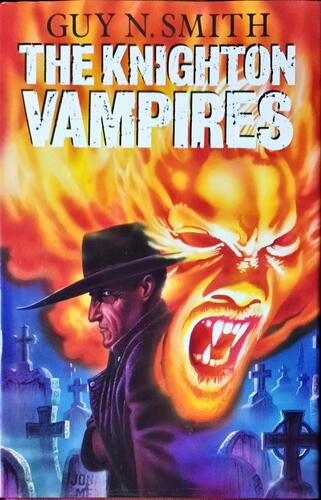
We had a wonderful time and everyone we met was very welcoming, but Mayo, albeit entirely by accident, arrives at a particularly tense time. As early as page fifteen, we learn about "escalating evil", enough to wonder if this second book will venture into the horror that the glorious Luis Rey cover art suggests or remain in the same thriller mode as 'The Black Fedora'. There are hippies in town, unnerving the locals. Welsh nationalist graffiti springs up everywhere, amidst an apparent campaign of terror that only targets the English. That includes the burning of houses, sometimes with their occupants still inside, but when we see what happens to one, it's a girl with fangs doing the deed.
I'll spoil one thing in the name of fair expectations and that's to say that this is another thriller. It boasts plenty of horror iconography, not least the vampires of the title, and the death count isn't skimped on; in fact it's higher than some of Smith's actual horror novels. However, it firmly stays in thriller territory throughout, every supernatural suggestion explained rationally. How, I won't tell you. You should read this for yourself to find out, benefitting as you do so from this being the first hardcover edition in Smith's fictional output. Until this point, his hardbacks were non-fiction books. No, 'Moles and Their Control' isn't another creature feature novel. Trust me.
This isn't as much of an ensemble piece as 'The Black Fedora', but there are still many characters to work through as you try to figure out what's really going on in Knighton. Initially, they're only introduced to be killed off, like John Trevino, hiding from dubious English real estate deals under a fake name, with his girlfriend who models in porn mags and shoots home videos with him. They only last one chapter before they're burned alive in their Welsh retreat. Some are introduced as ways to add a little horror flavour, like Carl Minton, who works for his parents at the George and happily offers to lend Mayo a video of 'I Bought a Vampire Motorcycle'.
Soon, though, they're introduced as suspects. Mrs. Tomlinson thinks it's Billy Quick, who still lives with his mum for whom he acquires drugs. Maybe it's Gareth Ingram, the small-time local dealer he buys from. It could be the big boys, whoever they are, moving into town to take over the local business. Billy thinks it's the new guy at the George, i.e. Mayo, who does look rather suspicious to the local authorities, especially as an Englishman who's in town for no apparent reason at a time of heightened nationalist fervour. Mayo even sees Penny in the street, one of the vampires of the title, all of whom seem to be young ladies. However, he knows intellectually that she's dead.
It doesn't seem likely to be the Keeper, Sid Knowles, who's ninety-three but still takes care of the clocktower after fifty years of service. He's mostly a gardener, happy to be still working, the sort of glorious old school rural character that we often run into in Smith's novels. If he'd have popped into the George's bar for his nightly ritual of two Newcastle Brown Ales while I was there, I'd have bought one for him. He might not have accepted it though. I was a stranger in town, one from the other side of the border and wearing a kilt for good measure. He'd have chatted though.
Maybe it's Glyn Idle of Idle Estates, a Welshman who's buying up all the property he can, but he's also possibly here only to introduce us to Gwenda Llanbich, who works in one of his offices. She's newly single, after her husband left her, and she and Mayo clearly hit it off on their first meeting. She does become a little more than just a Pat Benson type character, there for sexual distraction and generic support, not least because her branch of Idle Estates is firebombed that evening. It's a busy night in town, with multiple characters attacked by vampires, including Mayo himself. The hippies continue to lurk around for no apparent reason too and when the fair comes to town, the opportunities for chaos only increase.
I liked this, but in different ways to 'The Black Fedora'. It's not as deep or mysterious or grounded in a historical backdrop. Knighton is put to very good use, beyond its border geography making it a gimme of a location for growing Welsh nationalism. I like the place and Smith did too, so much in fact that he even managed to include himself in the story, not as a cameo per se but as an aside, a local character Sid Knowles remembers as he's laughing at modern trends. Organic gardening, to him, is what his family had been doing for centuries, just with a trendy label on it. So, in case you wouldn't catch it, this paragraph refers to Guy himself:
"Some chap in a crappy blue van came from over Clun way, two or three times a week, to bring them veg; he was on the make, too. People said he was a writer or somethin', kept a smallholding for his son to run, made the lad's wages up out of what they could grow without using any chemicals, and folks queued to buy it."
Maybe he'd have showed up in book three, which is clearly left a good possibility during the finalé, but that was never written. I do wonder why, because the John Mayo books were clearly a way for Smith to diversify his horror output into thriller territory without quite losing the horror flavour that his fans were lapping up. Horror fiction in the UK was absolutely changing at the time, with a new wave of writers taking over either with a more literary dark fantasy approach or just a more American psychological style. Smith's creature features were on their way out and he knew it.
However, I'm pretty sure I know the answer too, because there's context to why these two books were brought out by different publishers. 'The Black Fedora' was a paperback released by Sphere Books in 1991, but 'The Knighton Vampires', was a hardback published in 1993 by Piatkus. Today, it seems that both publishers belong to Little, Brown, but they were bought separately, Macdonald & Co, Sphere's parent company, in 1992, as part of the collapse of Robert Maxwell's media empire, but Piatkus only after its founder, Judy Piatkus, retired in 2007.
The key event in the middle of that was the death of Robert Maxwell, a major figure in the UK, as a multi-term Labour MP in the sixties; a litigious businessman whose empire included newspapers, publishers and even a football team, Oxford United; and a suspected spy, maybe a double or even triple agent potentially working for MI6, the KGB and Mossad. He died in late in 1991 after falling off his yacht and it didn't take long to discover that he had embezzled millions of pounds from the pension funds of his companies, sparking their collapse or sale with Sphere going to Little, Brown. It was huge news at the time but, in 2026, we'd notice the name of that yacht, the 'Lady Ghislaine', named after his daughter. Yes, the Ghislaine Maxwell who trafficked children for Jeffrey Epstein.
Needless to say, Sphere wasn't publishing any more books in 1992, though I do own a cover proof for the intended Sphere paperback edition of 'The Knighton Vampires', which featured the same cover art but different text overlay. Instead, Smith was able to reposition this novel with a new publisher, Piatkus, who would release two further novels in hardback editions over the next two years. 'The Plague Chronicles' was also published in 1993, while 'The Hangman' followed in 1994, under the pseudonym of Gavin Newman. I'll be tackling those in June and July.
At the time, Smith was also writing for Arrow and Grafton, but those contracts were over as well, albeit coincidentally, I believe, as Arrow was part of Random Century Group and Grafton part of HarperCollins Publishers. 1993 was the year when Smith didn't just shift to one new publisher but three. Piatkus was the first. Next month, I'll review 'Witch Spell', his first original novel published in the United States and the first of four for Zebra Books. And, in between his other two books for Piatkus, Julia MacRae Books started to issue his animal novels for children, under the pseudonym of Jonathan Guy. The times they were a-changin'. ~~ Hal C F Astell
For more titles by Guy N Smith click here
|
|